


Top Rugged Military PCs for Global Buyers?
Choosing a rugged military pc now means evaluating mission reliability, not simply buying the thickest laptop. A field operator may work beside a vibrating vehicle, under harsh sunlight, with wet gloves and limited charging access. The device must remain readable, responsive, and serviceable when ordinary office computers fail.
MarketsandMarkets estimates that the global rugged electronics market could grow from about USD 9.2 billion in 2024 to USD 13.8 billion by 2029. Its research identifies defense, transportation, and industrial operations as major demand sectors. VDC Research has also highlighted the importance of lifecycle support, mobile workforce productivity, and device survivability in rugged computing decisions. These findings suggest a practical truth: certification alone does not guarantee mission value. Sometimes, it only increases the brochure’s confidence.
David Krebs, executive vice president at VDC Research, has described the core buying principle this way: “Rugged technology must reduce operational risk, not just survive a drop.” That perspective should guide every global comparison. Buyers should examine MIL-STD-810H testing, IP ratings, sunlight-readable displays, glove-friendly controls, battery options, repair networks, and long-term software support. A sealed magnesium chassis looks impressive on a table. It matters more after dust enters a convoy, temperatures fall below freezing, or a replacement battery is unavailable overseas. Procurement teams should also verify test documentation with manufacturers. Marketing language can be vague. Even respected products may have limitations. Our guide compares leading rugged military pc platforms through that realistic lens, balancing protection, performance, security, maintainability, and total ownership cost.
Military PC Categories and Ruggedness Standards
Top Rugged Military PCs for Global Buyers?
Military PC Categories and Ruggedness Standards
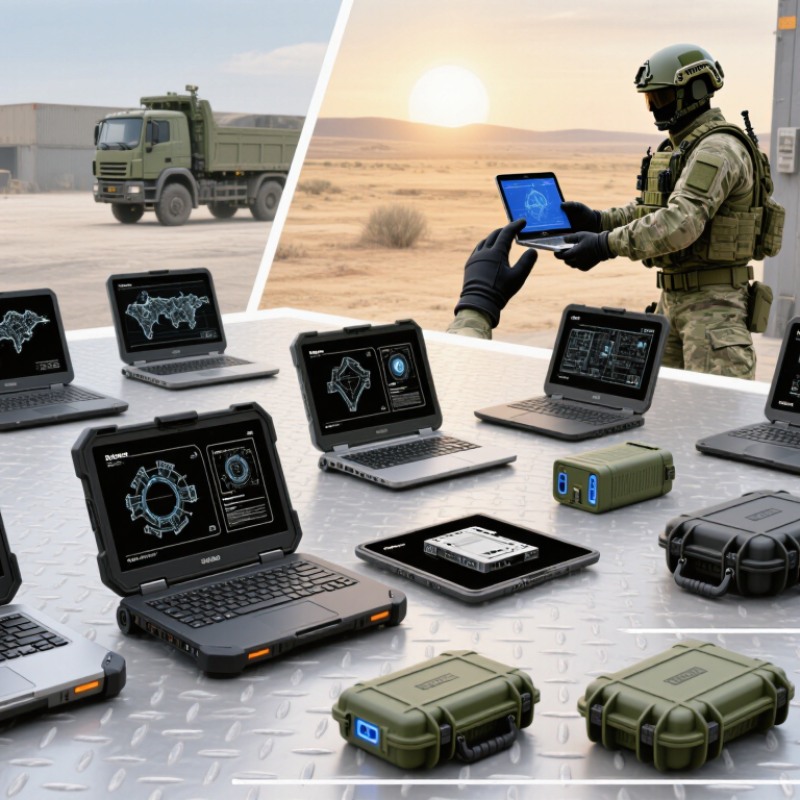
Rugged military PCs usually fall into four categories: vehicle-mounted computers, portable laptops, panel PCs, and compact edge servers. Vehicle systems need vibration control and stable power input. Portable units need sealed ports, sunlight-readable screens, and hot-swappable batteries. Panel PCs suit control rooms, while edge servers process sensor data near the operating area. The choice depends on mobility, installation space, and maintenance access.
The 2024 Fortune Business Insights report estimates the global rugged electronics market at about USD 10.57 billion in 2024. It projects growth to approximately USD 14.88 billion by 2032. This growth reflects demand for computing equipment that survives dust, moisture, shock, and temperature changes. Buyers should examine MIL-STD-810H test methods, not just the standard’s name. The document covers procedures for vibration, humidity, altitude, shock, and temperature. One test does not prove total ruggedness.
Ingress protection also needs careful reading. IEC 60529 ratings such as IP65 describe resistance to dust and water jets. They do not confirm electromagnetic compatibility. MIL-STD-461G testing addresses conducted and radiated interference, which matters inside crowded vehicles. A sealed connector may still fail after repeated cable movement. That detail is easy to miss. I would request laboratory reports, test conditions, sample configurations, and failure limits before purchase. Certification language can sound stronger than the evidence. Real deployment data, repair records, and thermal measurements often reveal more. A computer surviving a brief shock is not the same as operating reliably for years.
Top Rugged Military PCs for Global Buyers? - Military PC Categories and Ruggedness Standards
A practical comparison of rugged military computer categories, typical procurement requirements, and internationally recognized environmental and electromagnetic standards.
| Military PC Category | Typical Deployment | Primary Design Priorities | Typical Environmental Criteria | Relevant Standards and Ratings | Typical I/O and Expansion | Best Fit for Global Buyers |
|---|---|---|---|---|---|---|
| Rugged Panel PC | Vehicle dashboards, command posts, field-control stations, and industrial defense interfaces. | Sunlight readability, glove-friendly touch operation, sealed construction, vibration resistance, and simple mounting. | Typical operating temperature requests range from approximately -20°C to +55°C; wider ranges may be specified for specialized deployments. | MIL-STD-810H IP65/IP66 IEC 60068 | Ethernet, USB, serial ports, isolated digital I/O, CAN bus, video input, and optional wireless connectivity. | Users requiring a fixed, operator-facing computer with a sealed display and integrated computing platform. |
| Rugged Embedded Computer | Unmanned systems, sensor gateways, mission electronics, surveillance platforms, and communications equipment. | Compact dimensions, low power consumption, fanless cooling, long service life, and integration flexibility. | Designed for shock, vibration, thermal cycling, dust, humidity, and altitude conditions defined by the project specification. | MIL-STD-810H MIL-STD-461G IEC 60068 | COM Express or other modular expansion, Ethernet, serial interfaces, GPIO, CAN, storage interfaces, and PCIe options. | System integrators needing a computing subsystem rather than a complete operator workstation. |
| Vehicle-Mount Computer | Armored vehicles, logistics fleets, mobile command vehicles, and tactical transport platforms. | Secure mounting, ignition control, wide DC input, transient protection, vibration resistance, and sunlight-readable displays. | Typical vehicle requirements include 9–36 VDC or 18–36 VDC input ranges, conducted transients, vibration, shock, and thermal variation. | MIL-STD-810H MIL-STD-461G IP65/IP66 | CAN bus, serial ports, Ethernet, USB, GPS/GNSS, cellular or Wi-Fi connectivity, video capture, and isolated power input. | Organizations deploying computers in moving platforms where power quality, vibration, and rapid servicing are major concerns. |
| Rugged Laptop | Field maintenance, intelligence collection, communications, mapping, diagnostics, and mobile command activities. | Portability, daylight-readable display, sealed keyboard, drop resistance, battery endurance, and field repairability. | Common procurement targets include resistance to drops, rain, dust, vibration, humidity, and operation across sub-zero and hot environments. | MIL-STD-810H IP65 IEC 60529 | Docking connector, Ethernet, USB, serial port, removable storage, smart-card reader, wireless networking, and optional GNSS. | Mobile teams that need a complete computer, integrated display, keyboard, battery, and connectivity in one transportable unit. |
| Rugged Tablet | Digital maps, inventory control, maintenance workflows, patrol operations, medical logistics, and secure data collection. | Low weight, touch usability, glove operation, sunlight readability, battery replacement, and one-hand handling. | Typical requirements include drop resistance, rain and dust protection, vibration resistance, and operation in a broad temperature range. | MIL-STD-810H IP65/IP67 IEC 60529 | USB, docking contacts, barcode or RFID options, GNSS, secure wireless communication, cameras, and expansion docks. | Field personnel prioritizing mobility, rapid data entry, and lower weight over extensive internal expansion. |
| Rugged Workstation | Command-and-control rooms, sensor analysis, simulation, image processing, mission planning, and technical engineering. | High processing capacity, graphics performance, storage reliability, thermal management, and electromagnetic compatibility. | Environmental requirements are often installation-specific; shock, vibration, dust control, and redundant cooling may be requested. | MIL-STD-810H MIL-STD-461G IEC 60068 | Multiple Ethernet ports, high-speed storage, PCIe expansion, professional graphics, serial interfaces, and redundant power options. | Fixed or semi-mobile applications requiring more computing and graphics performance than a field laptop or embedded unit. |
| Rugged Server | Mobile data centers, tactical networks, edge computing, communications shelters, and forward operating locations. | Network availability, storage redundancy, remote management, serviceability, secure boot, and controlled thermal performance. | Ruggedized rack or transit cases may be specified for shock, vibration, temperature, humidity, dust, and altitude conditions. | MIL-STD-810H MIL-STD-461G IP rating by enclosure design | Redundant Ethernet, RAID or other storage protection, remote management, serial console, GPU or accelerator options, and redundant power. | Deployments that need local processing, virtualization, data storage, and network services outside a conventional data center. |
| Rugged Display and Mission Monitor | Vehicle consoles, tactical shelters, command centers, radar systems, and sensor visualization stations. | Optical clarity, sunlight readability, night-vision compatibility, sealed front panel, low latency, and mounting flexibility. | Typical requirements include resistance to vibration, shock, humidity, dust, temperature cycling, and electromagnetic interference. | MIL-STD-810H MIL-STD-461G IP65/IP66 | HDMI, DisplayPort, DVI, SDI, VGA, serial control, Ethernet, optical inputs, and configurable power interfaces. | System designs where the computer and display are procured separately or where multiple screens are required. |
Note: MIL-STD-810H is a test-method framework rather than a universal pass/fail certification. Applicable methods, procedures, severity levels, IP ratings, EMC limits, operating temperatures, and power requirements should be confirmed against the specific procurement statement of work. IP ratings are defined by IEC 60529, while MIL-STD-461G addresses electromagnetic interference and susceptibility requirements.
Related Posts
-
Top Ruggedized Computers for Harsh Environments?
-
10 Best Ruggedized Computers for Industrial Use?
-
10 Best Rugged PCs for Industrial Use in 2026
-
Exploring the Power and Durability of Rugged Industrial Computers in Harsh Environments
-
What Is an Industrial Portable Computer?
-
How to Choose the Right Military Panel PC for Your Operational Needs