Choosing the right rugged panel pc manufacturer is rarely a simple comparison of product pages. In factories, ports, warehouses, and outdoor control rooms, reliability depends on more than processor speed. A bright screen must remain readable beside welding sparks. A sealed enclosure must resist dust, moisture, vibration, and repeated cleaning. These details often decide whether equipment supports operations or creates another maintenance problem.
This guide examines ten leading rugged panel pc manufacturers through practical and technical criteria. We consider display visibility, enclosure design, IP and NEMA protection, operating temperature, mounting options, touch technology, and long-term component availability. Service quality matters too. A strong supplier should provide clear documentation, responsive engineering support, and realistic delivery information. Certifications and published test results also deserve careful attention, although marketing language can sometimes sound stronger than the evidence.
The list is not presented as an absolute ranking. Application requirements vary significantly. A panel PC designed for a clean production line may not suit a vehicle, marine cabinet, or dusty processing area. We compare each manufacturer’s experience, customization capability, integration support, and reputation across demanding environments. Real-world deployment feedback is valuable, but it is not always complete or independently verified. That limitation should remain visible.
Expect practical observations, not effortless conclusions. The best choice may involve trade-offs between price, performance, repairability, and lifecycle support. Small details matter. A poorly placed port can slow maintenance. A weak mounting bracket can undermine an otherwise excellent computer. This overview aims to help technical buyers ask sharper questions before selecting a trusted partner.
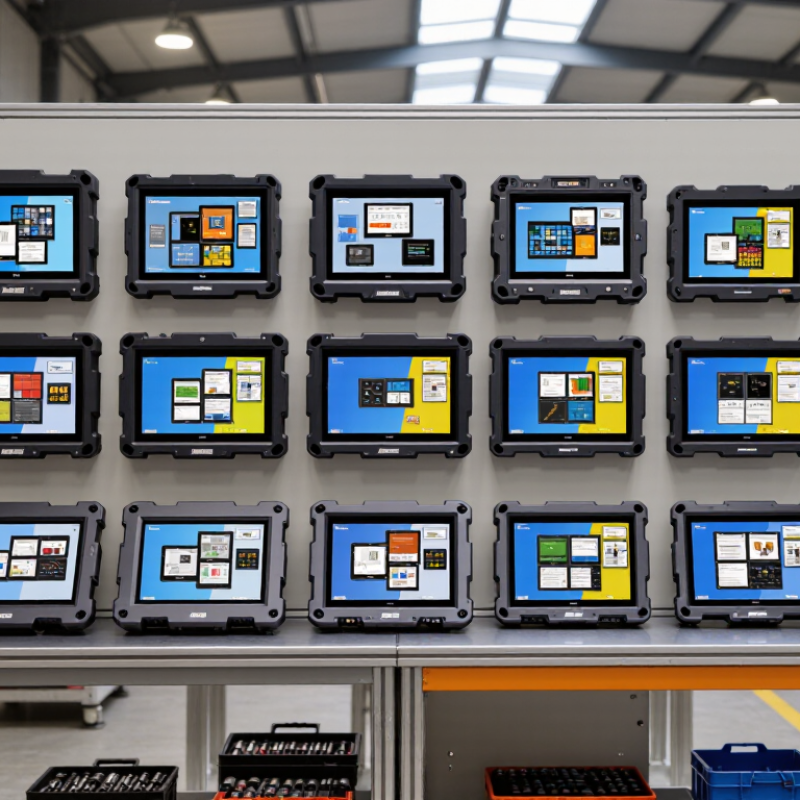
Rugged panel PCs are industrial computers built for harsh environments. They combine a display, processor, storage, and touch interface in one sealed enclosure. Unlike office computers, they tolerate dust, vibration, moisture, temperature changes, and continuous operation. Their value appears beside conveyor belts, machine tools, outdoor cabinets, and food-processing lines.
MarketsandMarkets estimates that the global industrial PC market will grow from about USD 5.6 billion in 2024 to nearly USD 8.0 billion by 2029. This growth reflects demand for reliable edge control and real-time production data. A rugged panel PC usually includes an IP65 or higher front rating, meaning protection against dust and low-pressure water jets. However, IP65 does not guarantee chemical resistance or full enclosure protection. That distinction is often missed.
Key features include fanless cooling, wide-temperature operation, sunlight-readable displays, glove-compatible touchscreens, and shock-resistant storage. Some models support 9–36 VDC input, useful in vehicles and unstable industrial power systems. IEC 60529 defines IP protection levels, while MIL-STD-810H test methods help assess vibration, shock, humidity, and temperature stress. These standards support comparison, not automatic reliability. A device can pass laboratory tests and still fail after poor cable sealing or incorrect installation. Grand View Research also identifies automation and connected manufacturing as major drivers of industrial computing demand. In practice, buyers should examine thermal design, mounting strength, connector placement, service access, and the supplier’s test evidence—not only screen size or processor speed.
Rugged panel PCs are commonly evaluated by enclosure protection, thermal design, mounting flexibility, display usability, and resistance to industrial environments. This chart uses the IEC 60529 water-jet test flow rates as an objective reference for understanding IP-rated protection: IPX5 uses 12.5 L/min, while IPX6 uses 100 L/min. IPX7 is an immersion test and therefore has no water-flow value.
A credible top-ten list should begin with evidence, not advertising. MarketsandMarkets’ 2023 Industrial PC report valued the sector at about USD 5.4 billion and projected roughly USD 7.4 billion by 2028. This growth increases the need for measurable quality. Manufacturers should provide complete test records for IEC 60529 ingress protection, especially IP65 or IP66 claims. A product photo proves little.
Environmental performance matters. Check IEC 60068 testing for vibration, shock, humidity, and temperature changes. For mobile or outdoor installations, MIL-STD-810H methods can provide useful evidence, although they do not automatically guarantee field reliability. Ask for test conditions, sample sizes, and failed-test records. Honest documentation is more valuable than a perfect-looking certificate.
Reliability needs numbers. Compare MTBF calculations, operating temperature ranges, touchscreen durability, and component replacement policies. VDC Research’s embedded computing studies repeatedly highlight long product lifecycles and supply continuity as important purchasing factors. A manufacturer should disclose processor availability, firmware support, and repair procedures. Ask for response times.
Field experience also matters. Request references from factories with dust, oil mist, or continuous shifts. Review warranty exclusions carefully. One weakness remains: MTBF figures can depend on different models and assumptions, so direct comparisons may be unfair. I would score transparency separately. A rugged panel PC is not truly rugged when its documentation is fragile.
What Are the Top 10 Rugged Panel PC Manufacturers?
Market reputation matters more than a polished product page. The top ten rugged panel PC manufacturers are usually recognized for stable delivery, long product lifecycles, responsive service, and dependable field performance. MarketsandMarkets estimates that the global rugged display market will grow from about USD 6.1 billion in 2023 to nearly USD 9.7 billion by 2028. This growth reflects demand from transportation, factory automation, energy, and outdoor monitoring.
Reputation should be measured through evidence. Look for IP65 or higher protection, wide-temperature operation, sunlight-readable screens, shock resistance, and compliance documentation. A manufacturer with strong engineering support can simplify panel mounting, glove operation, and integration with legacy systems. IDC research on industrial digital transformation also shows that reliability and system availability remain major investment priorities for industrial users. That makes warranty handling and spare-part access important ranking factors.
The ranking is not flawless. A large manufacturer may offer excellent global support but slower customization. A smaller specialist may provide better technical communication and faster design changes. Real evaluation should include customer references, failure-rate records, firmware policy, and repair turnaround time. Grand View Research projects continued expansion in the industrial PC market, but market growth does not automatically prove product quality. Test the unit in dust, vibration, heat, and direct light before purchase. Field evidence matters.
The top ten rugged panel PC manufacturers differ mainly in engineering focus, not appearance. According to MarketsandMarkets, the industrial PC market is projected to grow steadily through 2028, driven by automation and edge computing. Manufacturer 1 emphasizes fanless, low-maintenance systems for factory lines. Manufacturer 2 offers high-brightness displays for outdoor kiosks and transport terminals. Manufacturer 3 is stronger in stainless-steel housings for food-processing environments. Manufacturer 4 focuses on compact units for vehicle fleets and warehouse equipment.
Manufacturer 5 develops wide-temperature computers for oil, gas, and remote energy sites. Its sealed enclosure matters when dust enters ordinary office hardware. Manufacturer 6 supplies high-performance processors for machine vision and robotic inspection.
Manufacturer 7 specializes in sunlight-readable screens for ports, railways, and traffic control rooms. Manufacturer 8 provides modular designs, allowing users to replace storage, memory, or I/O components. That flexibility can reduce downtime, although it may increase procurement complexity.
Manufacturer 9 targets medical and laboratory workflows with easy-clean surfaces and stable touch input. Manufacturer 10 concentrates on defense and field service applications, where shock resistance and glove operation are practical requirements.
The IEC 60529 standard helps buyers compare IP ratings, while MIL-STD-810H testing indicates resistance to selected environmental stresses. Neither standard guarantees perfect field performance. That distinction is often missed. A 2024 industrial automation report from Grand View Research also highlights edge processing as a key adoption driver. In practice, buyers should test screen visibility, cable access, thermal behavior, and touch accuracy at the installation site. Paper specifications rarely reveal every weakness.
Choosing among the top 10 rugged panel PC manufacturers requires more than comparing screen size or processor speed. Start with the operating environment. A food-processing line may need an IP65 front panel, stainless steel housing, and sealed connectors. A vehicle platform may require shock testing, wide-temperature operation, and vibration evidence.
Market data can guide the shortlist. MarketsandMarkets estimates the industrial PC market will grow at a mid-single-digit annual rate through 2028. Grand View Research also identifies automation and edge computing as major demand drivers. However, market growth does not prove product reliability. Reports often combine several computer categories, which can make rugged panel PC figures less precise.
Ask each manufacturer for complete test records, not marketing claims. Check IEC 60529 ingress ratings, temperature limits, vibration methods, and compliance with relevant environmental standards. Request failure-rate data, warranty terms, spare-part availability, and guaranteed product lifecycles. A five-year supply commitment can matter more than a faster CPU. It reduces redesign risk on a production floor.
I would also test the actual unit before purchasing. Wear gloves. View the screen under direct sunlight. Connect the cables repeatedly. Small weaknesses appear quickly. No checklist is perfect. One overlooked mounting bracket or poorly placed USB port can delay installation and increase maintenance costs. Compare at least three quotations, but compare engineering evidence equally. A lower price may hide shorter support, weaker sealing, or expensive custom integration.
| Rank | Anonymous Manufacturer Profile | Typical Display Range | Typical Protection Level | Operating Temperature | Processor Options | Industrial I/O | Mounting Options | Customization Capability | Best-Fit Application | Key Evaluation Priority |
|---|---|---|---|---|---|---|---|---|---|---|
| 1 | Profile A: High-Durability Industrial Specialist | 10.1–21.5 in. | Front IP65 or higher | Typically -20°C to 60°C | Low-power x86 or ARM | LAN, USB, serial, digital I/O | Panel, VESA, desktop | High | Factory automation and machine control | Ingress protection and long-term availability |
| 2 | Profile B: Transportation-Grade Computing Supplier | 10.4–19 in. | Front IP65; sealed enclosure options | Typically -30°C to 60°C | Embedded x86 | Isolated serial, LAN, USB, CAN options | Panel, VESA, vehicle mounting | Medium to high | Rail, fleet, and onboard systems | Vibration resistance and power-input stability |
| 3 | Profile C: Hygienic Stainless-Steel Systems Provider | 12.1–21.5 in. | Front IP65 to IP69K options | Typically 0°C to 50°C | Fanless x86 | Sealed USB, LAN, serial | Panel and articulated-arm mounting | Medium | Food, beverage, and pharmaceutical production | Washdown resistance and cleanability |
| 4 | Profile D: Maritime and Outdoor Deployment Specialist | 10.4–23.8 in. | Front IP65 or higher | Typically -20°C to 55°C | Low-power x86 or ARM | LAN, serial, USB, isolated I/O | Panel, VESA, console mounting | High | Marine consoles and outdoor monitoring | Sunlight readability, corrosion resistance, and sealing |
| 5 | Profile E: Medical and Clinical Computing Supplier | 15.6–23.8 in. | Front IP65; antimicrobial options | Typically 0°C to 45°C | Embedded x86 | LAN, USB, serial, display output | Wall, VESA, cart, and panel mounting | Medium to high | Patient-care areas and laboratory equipment | Cleaning compatibility, electrical safety, and serviceability |
| 6 | Profile F: Logistics and Warehouse Automation Provider | 10.1–15.6 in. | Front IP65 | Typically -10°C to 50°C | Low-power x86 or ARM | LAN, USB, serial, wireless options | Panel, VESA, forklift, and wall mounting | Medium | Warehouse management and material handling | Wireless integration, touch reliability, and fast replacement |
| 7 | Profile G: Energy and Utility Monitoring Supplier | 12.1–21.5 in. | Front IP65 | Typically -20°C to 60°C | Fanless x86 | Multiple LAN, serial, USB, and fieldbus options | Panel, rack, and VESA mounting | High | Substations, control rooms, and utility assets | Power-input range, isolation, and remote management |
| 8 | Profile H: Vision and Edge-Computing Integrator | 15.6–27 in. | Front IP65 | Typically 0°C to 50°C | Higher-performance x86 | LAN, USB 3.x, display output, camera interfaces | Panel, VESA, and arm mounting | High | Machine vision and edge analytics | Processing headroom, thermal design, and expansion |
| 9 | Profile I: Cost-Optimized OEM Panel PC Manufacturer | 7–21.5 in. | Front IP65 on selected models | Typically 0°C to 50°C | Entry-level x86 or ARM | LAN, USB, serial | Panel and VESA mounting | High | Commercial equipment and standard HMI projects | Total cost, minimum order quantity, and lead time |
| 10 | Profile J: Configurable Project-Engineering Partner | 10.1–23.8 in. | Front IP65 or higher | Typically -20°C to 60°C | x86, ARM, or customer-specified platform | Configurable LAN, USB, serial, fieldbus, and wireless | Panel, VESA, rack, and custom mounting | Very high | Complex OEM and system-integration projects | Engineering support, documentation, validation, and lifecycle planning |