

Global sourcing demands more than a low unit price. It requires stable performance across different markets, suppliers, and shipping conditions. A 360 degree swivel stand can improve product access, viewing comfort, and workspace flexibility. It allows a screen, display, or mounted device to turn smoothly without lifting the base. Small movement. Real value.
Ergonomics researcher Dr. Alan Hedge expressed a useful design principle: “Good design should support the user without demanding attention.” That idea fits a 360 degree swivel stand. Buyers should examine rotation resistance, bearing quality, load capacity, base stability, and cable clearance. A stand may rotate beautifully in a showroom, then loosen after repeated movement. That happens.
Global buyers also need practical evidence. Request material specifications, inspection records, packaging details, and product samples before placing a large order. Test the stand on uneven surfaces and during repeated rotations. Check whether screws remain tight after vibration and transport. Ask suppliers about replacement parts and quality-control procedures. These details reveal more than polished product photos.
A reliable supplier should explain tolerances clearly. It should not hide behind vague claims such as “premium quality.” Aluminum may reduce weight, while steel can provide stronger support. The right choice depends on the mounted load, installation method, and shipping budget. There is no universal winner. Sometimes, the swivel function is unnecessary.
This guide explores why buyers choose this design, where it creates measurable value, and where it may introduce avoidable cost. A careful decision begins with use conditions, not marketing language. Contentment with the first sample can be misleading. Test it again.
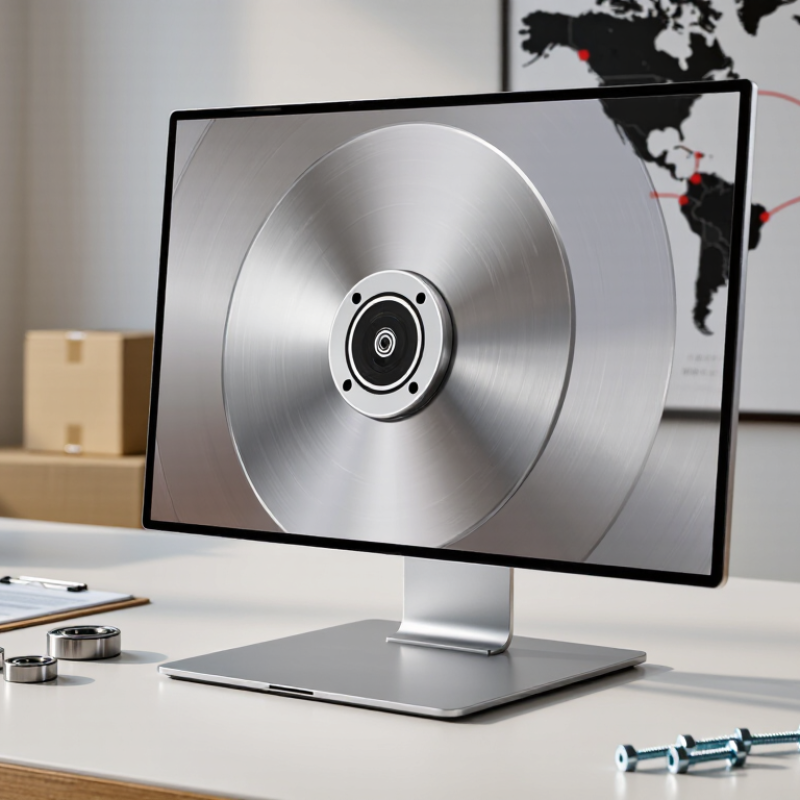
A 360° swivel stand is a support platform that rotates a product around a central vertical axis. It lets users view, present, or access an item from every direction without lifting it. In global sourcing, this feature can improve usability for displays, equipment, and compact workstations. However, rotation is not automatically better. The product’s weight, center of gravity, and working environment must be assessed first.
The mechanism usually includes a steel spindle, a turntable bearing, and a circular race containing ball bearings. When force is applied, the balls reduce sliding friction and distribute the load across the race. Some models use a friction plate for smooth movement. Others include detents or a locking pin at fixed angles. A reliable stand should rotate without grinding, wobbling, or sudden resistance. Check static load, rotating load, tilt resistance, cycle testing, and corrosion protection during supplier evaluation. Small defects become obvious after repeated use.
The WTO’s Global Trade Outlook and Statistics, published in April 2024, projected merchandise trade volume growth of 2.6% in 2024 and 3.3% in 2025. More cross-border purchasing increases the need for clear technical specifications. Buyers should request drawings, bearing materials, tolerance data, and inspection records. A 360° stand may save handling time, but poor bearing alignment can create noise and uneven rotation. That detail is easy to miss. It deserves testing before mass production.
More than 80% of global merchandise trade by volume moves by sea, according to UNCTAD’s Review of Maritime Transport 2023. This makes ocean freight central to global sourcing, especially for heavy or bulky goods. Products may pass through factories, warehouses, ports, and containers before reaching buyers. Small inspection gaps can become costly disputes.
A 360-degree swivel stand supports clearer product checks before shipment. Buyers can rotate a sample and inspect labels, fasteners, connectors, edges, and surface finishes. The stand also helps suppliers capture consistent photos from every angle. This detail matters when teams compare samples across countries and time zones. The World Bank’s Logistics Performance Index 2023 used 4,090 logistics assessments across 139 countries. Its findings emphasize tracking, logistics competence, and delivery timeliness. Better product visibility supports these operational priorities, even before cargo enters the supply chain.
It is not a magic fix. A poorly rated stand may wobble under load, damage delicate surfaces, or create another maintenance point. Sourcing teams should verify load capacity, locking strength, corrosion resistance, and replacement-part access. In coastal warehouses, salty air can expose weak materials quickly. A rotating base also adds weight and packaging volume, which may affect freight costs. That trade-off deserves honest review. The best choice is not always the most advanced one; it is the stand that remains stable, inspectable, and practical throughout international handling.
Why Choose a 360 Degree Swivel Stand for Global Sourcing?
A 360-degree swivel stand needs more than smooth rotation. Its base must resist tipping, twisting, and repeated impact. I normally begin with the working load, not the advertised maximum. A useful design target is a two-to-one static safety margin, although the final value depends on geometry and use conditions. The 2023 BIFMA X5.1 standard provides relevant durability benchmarks for swivel mechanisms, including demanding repeated-motion tests. A display stand is not an office chair, so copying that test blindly would be a mistake.
Cycle testing should represent real handling. Test samples should rotate under load, stop suddenly, and repeat in both directions. A practical sourcing protocol may include 50,000 to 100,000 cycles, followed by torque and wobble measurements. Record friction changes, fastener loosening, and bearing noise. Small defects matter. ASTM F2057-23 also reinforces the need to evaluate furniture stability and tip-over risks, especially when loads sit above the rotation axis.
Material selection affects long-term reliability. Die-cast aluminum reduces weight, while steel improves stiffness and thread strength. Engineering plastics can reduce noise, but heat and ultraviolet exposure may weaken them. ISO 12100 supports a structured risk-assessment process for machinery-related hazards. It does not replace product-specific testing. Supplier reports should show material grades, hardness, corrosion results, and test-fixture details. I would also request independent laboratory verification under ISO/IEC 17025. Paper compliance alone is not enough. Real-world alignment errors can still create disappointing results.
Why Choose a 360 Degree Swivel Stand for Global Sourcing?
Supplier Comparison: MOQ, Lead Time, Incoterms, and Total Landed Cost
A 360-degree swivel stand supports flexible product presentation, but sourcing decisions require more than attractive movement. Supplier comparison should begin with MOQ, lead time, and production consistency. A low MOQ may suit a market test, while larger orders can reduce unit pricing. Ask whether the quoted MOQ includes packaging, spare parts, and quality inspection.
Lead time needs careful definition. Some suppliers count from deposit payment, while others start after artwork approval. Request a production calendar with sample approval, manufacturing, inspection, and dispatch dates. A realistic schedule should include buffer time. Delays happen.
Incoterms can change the final price significantly. FOB may exclude ocean freight, export handling, and destination charges. CIF includes freight to the named port, but local fees may remain. DDP can simplify delivery, yet the quotation must clearly identify included taxes and services. Compare every offer using the same destination, currency, packaging standard, and shipment size.
Total landed cost should include the product, tooling, packaging, freight, insurance, duties, inland delivery, inspection, and possible rework. A supplier with the lowest unit price may create higher costs through weak cartons or inconsistent rotation resistance. I have seen comparison sheets omit port storage fees and replacement units. Those omissions distort the decision. Use written quotations, verified specifications, and shipment records before committing to a 360-degree swivel stand order.
Anonymous supplier comparison by MOQ, lead time, Incoterms, and total landed cost
Cost basis: USD per unit. Lead time refers to production time after order confirmation. Import duty and handling estimates vary by destination country and product classification.
When sourcing a 360-degree swivel stand, quality evidence matters as much as smooth rotation. In production reviews, I check the base, bearing movement, screw fit, and surface finish. A stable stand should rotate evenly without grinding or wobbling. ISO 9001 signals a controlled quality system, but it does not replace product-level inspection. Ask for inspection records, material details, and corrective-action reports. Small gaps often reveal larger process weaknesses.
RoHS and REACH documentation helps confirm responsible material control for international markets. These records should match the actual model, coating, and packaging used in your order. An AQL 2.5 inspection adds a practical sampling checkpoint before shipment. Inspectors may review dimensions, torque, scratches, labeling, and carton strength. Still, sampling has limits. I have seen acceptable samples hide inconsistent assembly in later cartons. That risk deserves open discussion, not optimistic assumptions.
Tips: Define rotation resistance and load capacity in writing. Request a pre-production sample. Compare it with the approved drawing. Use photos with measurement scales. Confirm inspection timing before final payment. Keep a signed report and retain random samples. If a supplier avoids raw test data, pause and ask why. Compliance is not a slogan. It is traceable evidence.
| Quality or Compliance Dimension | Applicable Standard or Requirement | What It Covers | Verification Evidence | Sourcing Value for a 360° Swivel Stand |
|---|---|---|---|---|
| Quality management system | ISO 9001:2015 | Controls how an organization manages processes, customer requirements, documented information, corrective action, and continual improvement. | Valid certificate issued by an accredited certification body; scope should include the relevant design, manufacturing, or assembly activities. | Helps establish repeatable controls for rotation components, fasteners, surface finish, packaging, and nonconforming-product handling. |
| Restricted substances | RoHS Directive 2011/65/EU, as amended by Commission Delegated Directive (EU) 2015/863 | Limits specified substances in electrical and electronic equipment, including lead, mercury, cadmium, hexavalent chromium, PBB, PBDE, and four phthalates. | Supplier declaration, material declarations, component records, and risk-based laboratory test reports for applicable parts. | Supports market access when the stand contains electrical, electronic, lighting, powered, or electronic accessory components. |
| Chemical substance control | REACH Regulation (EC) No 1907/2006 | Addresses the registration, evaluation, authorization, and restriction of chemical substances. Articles may also require communication when Candidate List substances exceed the applicable threshold. | Material composition statement, supplier declarations, and targeted testing based on plastics, coatings, metals, adhesives, and other risk areas. | Reduces chemical-compliance risk across painted surfaces, polymer parts, rubber feet, adhesives, and plated metal components. |
| Pre-shipment acceptance inspection | ISO 2859-1 sampling system; AQL 2.5 selected by contract | Uses lot size, inspection level, code letter, sample size, and acceptance/rejection numbers to evaluate a production lot. AQL is not a guarantee that every unit is defect-free. | Signed inspection report showing lot size, sampling plan, sample quantity, defect classification, findings, photographs, and acceptance decision. | Provides a consistent basis for checking swivel action, assembly, appearance, dimensions, packaging, and functional defects before shipment. |
| 360-degree rotation | Buyer-approved product specification | The stand should rotate through the specified range without binding, excessive play, scraping, or unintended movement. | Manual or fixture-based rotation test against the approved sample, drawing, or control plan; record abnormal noise, resistance, and visible damage. | Improves viewing flexibility and helps confirm that the swivel mechanism performs consistently across inspected units. |
| Load and stability | Approved load rating and stability criteria defined by the buyer | Confirms that the stand supports the specified load and remains stable in intended orientations and operating conditions. | Documented load test, tip-resistance assessment, dimensional check, and comparison with the approved technical drawing. | Helps prevent tipping, deformation, loose joints, or premature wear when the supported device is rotated or repositioned. |
| Mechanical durability | Buyer-defined cycle and performance test | Evaluates wear of the rotating joint, bearing, bushing, screws, locking features, and contact surfaces during repeated use. | Cycle-test records, before-and-after measurements, torque or resistance readings where specified, and visual inspection for cracks or loosening. | Supports reliable long-term operation without inventing a universal cycle count that may not match the product design. |
| Appearance and workmanship | Approved golden sample and visual defect limits | Covers scratches, dents, burrs, uneven coating, contamination, molding defects, sharp edges, gaps, and assembly misalignment. | Inspection under defined lighting and viewing distance, with defect photographs and agreed major/minor/critical classifications. | Protects perceived quality and reduces customer complaints caused by inconsistent finish or unsafe workmanship. |
| Traceability and corrective action | ISO 9001 process controls and buyer-specific records | Links inspected goods to production dates, materials, inspection results, deviations, and corrective actions. | Batch or lot identification, inspection records, nonconformity reports, root-cause analysis, and corrective-action verification. | Makes recurring defects easier to isolate and supports accountable, data-based global supplier management. |

