

Choosing the right Granulation Machine is a technical decision, not a simple equipment purchase. It affects particle uniformity, flowability, drying costs, cleaning time, and production reliability. A machine may look impressive in a showroom, yet perform poorly with your actual formulation. Material behavior matters more than polished photographs.
Recent analyses from Grand View Research on pharmaceutical manufacturing equipment and MarketsandMarkets on granulation equipment show continued investment in efficient, automated, and quality-focused processing systems. These reports also highlight demand for better process control, scalable production, and reduced material waste. In pharmaceutical operations, FDA Process Validation guidance and EU GMP expectations make repeatability, traceability, and documented cleaning essential considerations. The right choice must therefore connect engineering performance with compliance requirements.
This guide presents 10 practical tips for evaluating a Granulation Machine. It examines wet, dry, and high-shear granulation methods, while considering feed properties, target particle size, moisture sensitivity, throughput, energy use, and maintenance access. Imagine a powder entering the equipment at inconsistent moisture levels; a minor variation can create oversized granules, blocked screens, or unstable tablet compression. That detail matters.
Numbers can mislead.
Supplier claims also require verification. Ask for application trials, test data, validation support, and references from comparable facilities. Ideally, inspect the machine during operation, not only during a presentation. No selection method is perfect; laboratory results may not predict every full-scale challenge. Still, a structured review reduces avoidable risk and supports a more reliable investment.
Before choosing a granulation machine, define the target clearly. Are you producing dense, free-flowing granules or softer agglomerates? Record batch size, output rate, moisture level, particle-size range, and acceptable fines. These details affect rotor speed, screen design, drying demand, and cleaning time. Small differences matter.
Tip: Build a material profile first. Include bulk density, compressibility, shear sensitivity, heat exposure, and binder behavior. The U.S. FDA’s Process Validation guidance stresses that critical material attributes must connect with critical process parameters. That principle is practical, not decorative. A powder that feels dry may still bridge inside a hopper.
Reports can expose useful scale. Grand View Research estimates the global pharmaceutical granulation equipment market will continue growing through 2030, driven partly by demand for consistent solid-dose production. However, market forecasts vary because analysts define “granulation equipment” differently. Treat them as direction, not proof. Your own pilot data is stronger.
Tip: Test the actual formulation, not a substitute powder. Measure granule size distribution, moisture, flow rate, yield, and tablet performance after each trial. A 2023 European Pharmacopoeia-related review notes that particle-size control strongly influences flow and dose uniformity. That sounds obvious. It is often missed. Leave room for imperfect results, because scale-up may change mixing, heat transfer, and residence time.
10 Tips for Choosing the Right Granulation Machine?
Choosing a granulation machine starts with the material, not the equipment brochure. Wet granulation suits powders that need liquid binders and stronger, denser granules. Dry granulation uses compaction, making it useful when moisture or heat may damage the formulation. Melt granulation can reduce liquid handling, but temperature control becomes critical. Each technology changes particle size, density, drying needs, and energy use.
Machine configuration matters just as much. A high-shear mixer can process quickly, yet it may create uneven wetting if liquid addition is poorly controlled. Fluid-bed systems combine granulation and drying, saving floor space, but airflow must remain stable across the product bed. Roller compactors offer continuous processing and low moisture exposure. However, roll pressure, gap, and feeding consistency require close monitoring. For sensitive powders, a smaller batch unit may provide better control than a larger machine.
Look closely at the details. Check cleaning access, contact-surface design, sensor accuracy, and spare-part availability. Ask for trials using your actual powder, not a convenient substitute. Measure granule size, moisture, flowability, and tablet or downstream performance. I have seen teams focus on throughput and underestimate cleaning time. That was an expensive lesson. No configuration is perfect. The best choice may involve slower production, simpler validation, and easier operator control. Also question the data. A smooth trial does not always represent a full production shift.
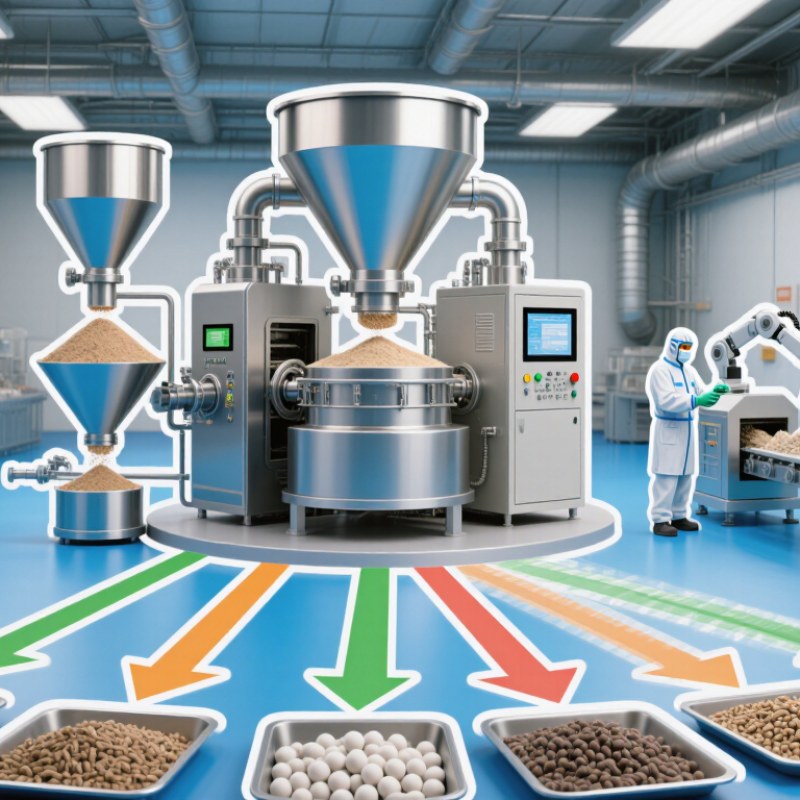
Compare granulation technologies and machine configurations by reviewing their typical finished granule-size ranges. Actual results depend on formulation, binder level, moisture content, screen size, compaction pressure, and process settings.
High-shear and fluid-bed systems are commonly selected when liquid binder distribution and controlled agglomeration are important. Roller compaction is suitable for dry processing and moisture-sensitive materials, while screen-based sizing is often used to control the final particle distribution after wet massing. When choosing a machine, also evaluate throughput, batch or continuous operation, cleaning requirements, containment, material sensitivity, scale-up behavior, and the required granule strength.
Capacity should match your real production rhythm, not an optimistic spreadsheet. Leave practical headroom for cleaning, changeovers, and moisture variation. A machine rated for 500 kilograms per hour may deliver less with sticky or poorly flowing powders. The 2024 Pharmaceutical Processing Equipment Market report by Fortune Business Insights projects continued growth in manufacturing capacity, increasing pressure to improve throughput and consistency.
Bigger is not always better.
Particle size affects dissolution, flow, tablet weight, and downstream compression. Define the target distribution, not only the average diameter. For example, a D50 value can hide excessive fines or oversized granules.
I recommend checking sieve fractions, bulk density, moisture, and friability during trials. USP <429> supports laser diffraction for particle-size measurement, but the method must suit the material. Results can shift with dispersion settings. That detail is easy to underestimate.
Process control deserves equal attention. Review torque, impeller speed, liquid addition rate, temperature, and endpoint detection. FDA’s Process Validation guidance recommends continued process verification using trend data, not one successful batch.
Choose equipment that records these variables clearly and supports repeatable recipes. In practice, operators often trust a stable motor load too much. It can be misleading.
Run pilot tests using your actual formulation, then compare three batches, including one deliberately challenging batch. A reliable machine should reveal variation before production does.
Choosing a granulation machine starts with the frame, not the brochure. Inspect welded joints, guards, fasteners, and contact surfaces under bright light. A rigid stainless-steel body should resist vibration during long production runs. Ask for material certificates and documented load tests when available. Good build quality protects output consistency and operator confidence. Yet polished panels can hide weak bearings. That happened in one trial I observed.
Safety needs practical checking. Look for interlocked covers, emergency stops, overload protection, grounding, and clear warning labels. Test each control before accepting the machine. The stop button matters most. Confirm that power isolation prevents unexpected restart during cleaning. Dust control also deserves attention, especially near motors and electrical cabinets. Request risk assessments, inspection records, and training instructions from the supplier. Do not accept vague promises. A machine may meet a standard, but its daily safeguards still need verification.
Maintenance requirements should fit your staff and schedule. Check access to screens, blades, seals, bearings, and lubrication points. Ask how often each part needs inspection, replacement, or calibration. Choose tools and spare parts available through ordinary industrial channels. Record cleaning time during a supervised test; estimates are often optimistic. I once underestimated screen-change time by nearly half an hour. That mistake affected shift planning. Keep service logs, photograph worn parts, and review recurring faults monthly. Small maintenance details often decide whether a reliable machine stays reliable.
| No. | Selection Tip | What to Evaluate | Practical Questions or Evidence to Request | Preferred Requirement |
|---|---|---|---|---|
| 1 | Match the machine to the material | Consider powder flowability, moisture sensitivity, particle size, formulation, and whether the material is abrasive or heat-sensitive. | Provide the supplier with representative material samples and request a trial using the intended formulation and process conditions. | Material compatibility confirmed Successful trials with acceptable granule quality and no excessive heat generation. |
| 2 | Check construction and weld quality | Inspect the frame, product-contact surfaces, welds, seals, hinges, and internal corners. Poor finishing can create contamination traps. | Ask for construction drawings, surface-finish specifications, weld inspection records, and details of crevice-free product-contact areas. | Hygienic construction Smooth, accessible, corrosion-resistant contact surfaces with fully finished welds. |
| 3 | Verify capacity and operating range | Compare batch size, feed rate, working volume, motor load, and usable operating range rather than relying only on maximum capacity. | Request performance data at the minimum, normal, and maximum intended loads, including output rate and granule-size results. | Stable throughput Capacity meets production demand without requiring continuous operation at the machine limit. |
| 4 | Review granule-size control | Evaluate impeller or rotor speed control, screen or sieve selection, cutting action, residence time, and the ability to adjust process parameters. | Ask for particle-size distribution data, operating-speed ranges, screen options, and documented changeover procedures. | Repeatable granules Consistent size distribution with minimal oversized particles and fines for the intended application. |
| 5 | Prioritize operator safety | Check guards, interlocks, emergency-stop devices, lid or door detection, overload protection, and safe access to moving parts. | Request the risk assessment, safety circuit description, emergency-stop test procedure, and applicable conformity documentation. | Safety controls verified Moving parts cannot be accessed during operation, and the machine stops safely when a protective device is triggered. |
| 6 | Assess dust and containment control | Determine whether the machine can be connected to a suitable dust-extraction system and whether seals limit powder leakage. | Ask for recommended extraction airflow, connection dimensions, dust-tightness information, and cleaning instructions for filters and ducts. | Controlled dust exposure Enclosed transfer points, effective seals, and suitable extraction for the processed powder. |
| 7 | Examine cleaning and changeover design | Look for tool-free access, removable screens or blades, drainable areas, smooth surfaces, and minimal product-retention zones. | Request a cleaning method, estimated cleaning time, parts-removal sequence, and information about wet or dry cleaning compatibility. | Short, repeatable cleaning All product-contact areas are accessible, inspectable, and easy to clean without damaging components. |
| 8 | Calculate maintenance requirements | Review wear parts, bearings, seals, blades, screens, lubrication points, inspection intervals, and the availability of replacement parts. | Ask for a preventive-maintenance schedule, spare-parts list, expected service life of wear components, and replacement instructions. | Predictable upkeep Routine maintenance is clearly documented, and critical spare parts can be obtained within the required timeframe. |
| 9 | Confirm controls and process monitoring | Evaluate speed adjustment, timer functions, motor-load monitoring, alarm handling, recipe storage, and data-recording capabilities. | Request a control-system demonstration and confirm whether operating parameters, alarms, and batch records can be exported or integrated. | Reproducible operation Key parameters are visible, adjustable within safe limits, and recorded consistently for each batch. |
| 10 | Compare total cost of ownership | Include purchase price, installation, utilities, tooling, cleaning labor, energy use, maintenance, downtime, training, and spare parts. | Request a lifecycle-cost estimate and clarify warranty coverage, commissioning support, operator training, response times, and service availability. | Value over service life The machine meets performance and compliance needs with manageable operating, maintenance, and downtime costs. |
Energy efficiency should be measured at the outlet, not promised in a brochure. Measure kilowatt-hours per tonne using your actual feedstock, moisture, screen, and target particle size. Test startup, steady production, and cleaning. Peak readings can reveal oversized motors or inefficient drives.
The U.S. Department of Energy reports that motor systems consume 50–70% of industrial electricity. The number is broad. Still, it deserves attention.
Supplier support is part of machine performance. Request documented response times, local service coverage, spare-part lead times, training hours, and escalation contacts. Ask for commissioning records and maintenance schedules.
One failed sensor can stop an entire line. Remote diagnostics help, but they are not magic. Check whether technicians understand your material, not merely the machine. Speak with comparable users when possible.
Build a five- to ten-year ownership model. Include purchase price, installation, electricity, knives, screens, labor, downtime, dust control, and disposal. ISO 15686-5:2017 identifies life-cycle costing as a method for comparing long-term asset costs.
The IEA’s Energy Efficiency 2023 report states that industry used about 37% of global final energy in 2022.
Compare suppliers using cost per saleable tonne, not hourly throughput. Ask for a witnessed acceptance test. That estimate can be wrong. Feedstock changes, and operators improvise. Document assumptions, then challenge them before signing.

