What Are Nitrile O Rings and What Are They Used For?
Nitrile O Rings are compact sealing components made from nitrile butadiene rubber, commonly called NBR. They sit inside a groove and deform against two surfaces. That controlled compression blocks leaks in pumps, valves, cylinders, fuel systems, and hydraulic equipment. The part looks simple. The engineering is not.
Dr. Robert Flitney, author of Seals and Sealing Handbook, emphasizes a practical truth: “A seal is only as good as the system in which it operates.” This principle explains why Nitrile O Rings remain widely used. They generally resist petroleum oils, lubricants, hydraulic fluids, and many fuels. Their balanced performance also makes them economical for automotive and industrial maintenance. A technician may select a black NBR ring for a hydraulic fitting, then verify its hardness, size, pressure, and temperature limits.
Small details matter.
Nitrile O Rings are not universal seals. Ozone, sunlight, weathering, and excessive heat can shorten their service life. Certain ester-based fluids and aggressive chemicals may cause swelling, cracking, or permanent deformation. Installation can also fail through twisting, sharp edges, dry assembly, or an incorrect groove. These are easy mistakes, even in experienced workshops. I have seen sealing problems blamed on “bad rubber” when the real issue was a scratched shaft or careless fitting. That possibility deserves attention. This guide examines what Nitrile O Rings are, where they perform reliably, and how engineers choose them with greater confidence. It also recognizes an uncomfortable fact: the cheapest seal is not always the lowest-cost choice.
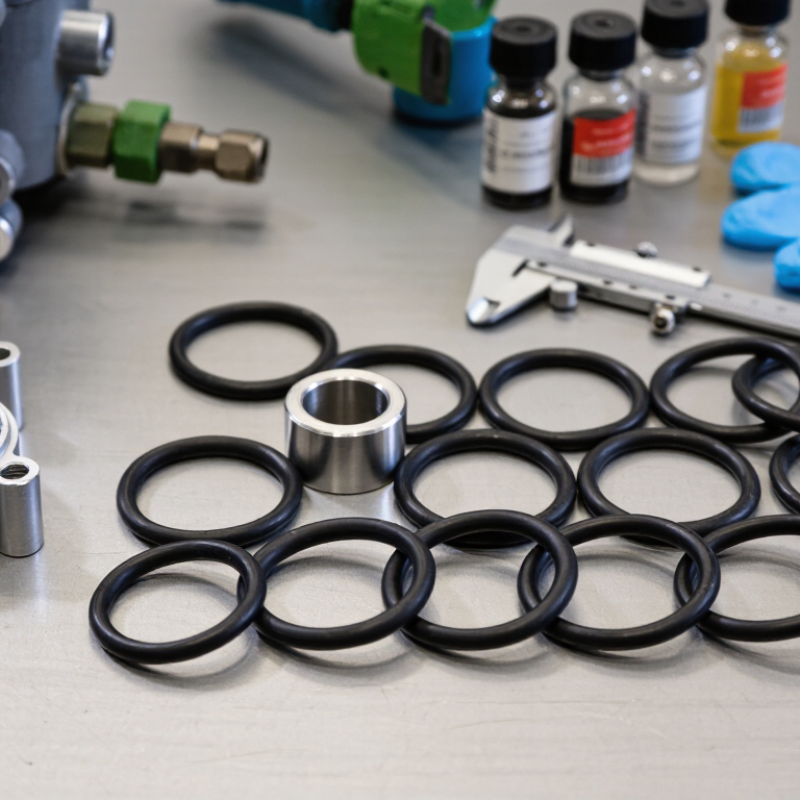
Nitrile O-Ring Fundamentals: NBR Composition and 18–50% ACN Grades
What Are Nitrile O Rings and What Are They Used For?
Nitrile O-rings are circular seals made from nitrile butadiene rubber, commonly called NBR. The material combines butadiene, which supports flexibility, with acrylonitrile, or ACN. ACN content typically ranges from about 18% to 50%. That percentage matters. Higher ACN generally improves resistance to oils and fuels, while lower ACN usually supports better flexibility at low temperatures. The trade-off is real: one grade rarely excels in every condition.
In use, an O-ring sits in a groove and compresses against a mating surface to help prevent fluid or air leaks. NBR is often selected for oil-handling equipment, hydraulic systems, and general industrial sealing. A technician should also check temperature, pressure, fluid compatibility, and movement at the seal. “Nitrile” alone does not identify a precise performance range. Compound recipes and manufacturing quality can vary, so a datasheet and application testing are more reliable than a material name. Even experienced buyers can overlook low-temperature performance when focusing on oil resistance.
Tips: Match the ACN grade to the actual fluid and operating temperature. Inspect the groove for sharp edges, dirt, or damage before installation. A seal that looks correct may still swell, harden, or lose flexibility in service. Test when conditions are uncertain.
Nitrile O-Ring Fundamentals: NBR Composition and ACN Grades
Nitrile rubber (NBR) is a copolymer of acrylonitrile (ACN) and butadiene. NBR grades commonly span about 18–50% ACN. Higher ACN content generally improves resistance to oils and fuels, while lower ACN content generally supports better flexibility at low temperatures. The ranges shown are illustrative; grade classifications vary by supplier and formulation.
NBR O-Ring Performance: ASTM D2000 Properties and −40 to 120°C Service
Nitrile O-rings, or NBR O-rings, are molded seals made from acrylonitrile-butadiene rubber. Their main advantage is resistance to mineral oils, fuels, and hydraulic fluids. ASTM D2000 classifies rubber compounds by hardness, tensile strength, elongation, heat aging, and fluid resistance. Many NBR specifications use M2BG-type requirements, but one grade cannot represent every compound.
The typical NBR service range is about −40 to 120°C. Actual limits depend on acrylonitrile content, plasticizer selection, pressure, and exposure time. At 70°C, a properly selected seal can retain useful elasticity in many oil systems. Near 120°C, however, compression set usually increases, especially under continuous pressure. ASTM D2000 heat-aging tests commonly use 70 hours at elevated temperature, while ISO 37 evaluates tensile strength and elongation. These tests offer comparison, not a lifetime guarantee.
A practical detail matters.
A seal installed in a cold valve may stiffen before leakage becomes visible. In a hot pump, the opposite problem appears: the rubber softens, swells, or loses recovery. Surface finish, groove fill, squeeze, and installation damage also influence performance. ISO 3601 provides dimensional guidance for O-rings, but it cannot predict every chemical mixture. This is where specifications become too neat. Real service conditions often change. Engineers should verify hardness, compound compatibility, and compression-set data under the actual temperature cycle, rather than relying only on the stated −40 to 120°C range.
Nitrile O-Ring Applications: Hydraulic, Pneumatic, Oil, and Fuel Systems
Nitrile O-rings, often called NBR seals, are made from synthetic rubber containing acrylonitrile. Their practical value comes from balanced resistance to petroleum-based oils, hydraulic fluids, and many fuels. In hydraulic systems, they seal pumps, valves, cylinders, and hose connections under changing pressure. A correctly sized ring prevents fluid loss and protects the system from air entering through a joint.
In pneumatic equipment, nitrile O-rings support reliable sealing around pistons, regulators, and air fittings. They work well with lubricated compressed air, but heat and ozone can shorten their service life. Fuel systems also use them around injectors, filters, tanks, and connectors when the compound matches the fuel formulation. Compatibility must be checked carefully. Not every black seal fits every fluid.
During installation, I inspect the groove for scratches, remove sharp edges, and apply a compatible lubricant. Excessive stretching, twisting, or compression can create early leakage. Temperature matters too; many standard nitrile compounds perform near -30°C to 100°C, but actual limits vary by formulation and pressure. A simple rule can mislead. High temperatures, sunlight, aggressive additives, or modern fuel blends may require another elastomer. In the field, a seal that looks perfect can still be chemically damaged, so checking swelling, hardness, and the manufacturer’s material data remains essential.
NBR Seal Specification: ISO 3601 Sizes, Hardness, and Pressure Factors
Nitrile O-rings, often called NBR seals, use an elastic circular profile to block fluids between two mating surfaces. They appear in pumps, hydraulic fittings, fuel systems, and pneumatic equipment. Their value is practical: good resistance to mineral oils, reliable compression recovery, and moderate cost. The seal works only when its size, hardness, and installation conditions match the joint. Small details matter.
ISO 3601 sizing gives a controlled reference for inside diameter, cross-section, and dimensional tolerances. Select the groove from the specified O-ring size, not from a loose visual match. A seal that looks correct may still twist, flatten unevenly, or leak. Common hardness choices range around 70 Shore A, while softer compounds improve low-pressure conformity and harder compounds resist extrusion better. Hardness alone is not enough. Compound formulation, temperature, fluid compatibility, and compression set also affect service life. NBR commonly handles many petroleum-based fluids, but its performance drops with strong ozone exposure, some chemicals, and unsuitable heat.
Pressure changes the design. As pressure rises, the O-ring can be forced into the clearance gap, causing nibbling or permanent damage. Reduce the extrusion gap, select a harder grade, or add a backup ring when necessary. Dynamic seals need additional attention because sliding motion creates friction and heat. Lubrication should match the fluid and seal compound. A clean groove with a light chamfer prevents cuts during assembly. Field inspection often reveals the real cause: incorrect squeeze, rough surfaces, or a twisted ring. One specification sheet cannot replace testing under actual pressure cycles. That limitation deserves attention.
What Are Nitrile O Rings and What Are They Used For? — NBR Seal Specification: ISO 3601 Sizes, Hardness, and Pressure Factors | Specification area | Typical information | Selection and design notes |
| Material | Nitrile rubber, also called NBR or Buna-N, is a synthetic elastomer made from acrylonitrile and butadiene. | Its resistance to oils and fuels varies with the compound’s acrylonitrile content and formulation. Check compatibility against the specific fluid and operating conditions. |
| ISO 3601 sizing | ISO 3601-1 specifies O-ring size designations and tolerances. Sizes are defined by inside diameter and cross-section; the standard includes metric and inch-based series. | Specify the applicable standard, nominal inside diameter, cross-section, and tolerances. Confirm that the selected size matches the gland design and the applicable standard edition. |
| Related ISO standards | ISO 3601-2 covers housing dimensions for general applications. ISO 3601-3 addresses quality acceptance criteria, including surface imperfections. | ISO 3601 dimensional conformity does not, by itself, define the NBR compound, hardness, fluid compatibility, or pressure rating. |
| Hardness | 70 Shore A is a widely used general-purpose hardness. NBR O-rings are also available in other hardnesses, commonly within approximately 60–90 Shore A. | Harder compounds can resist extrusion better in some designs but may require greater installation force and may seal less readily on rough or imperfect surfaces. Confirm the compound specification and test method. |
| Temperature range | A commonly quoted service range for general-purpose NBR is approximately −30°C to +100°C (−22°F to +212°F). | This is a typical guideline, not a universal rating. The actual range depends on the compound, fluid, exposure time, and static or dynamic service; consult the compound supplier’s data. |
| Pressure capability | There is no single pressure rating that applies to all NBR O-rings. | Pressure capability depends on gland geometry, clearance or extrusion gap, hardness, temperature, pressure cycling, and whether the seal is static or dynamic. Evaluate the complete design rather than relying on material or size alone. |
| Extrusion control | High pressure can force elastomer into an open clearance gap, potentially causing nibbling or extrusion damage. | Control clearance and use an appropriately designed gland. Backup rings may help limit extrusion in suitable applications; their need and configuration depend on the pressure, gap, material, and operating conditions. |
| Common applications | Hydraulic and pneumatic equipment, pumps, valves, fittings, machinery, and general industrial fluid sealing. | Choose the seal for the actual media, pressure, temperature, motion, and maintenance requirements. A common application does not establish suitability for every system. |
| Fluid compatibility | NBR is commonly selected for many petroleum-based oils and greases. | Compatibility varies by fluid formulation, additives, temperature, and exposure. NBR is generally not a first choice for ozone-rich or outdoor weathering exposure, many ketones, or some strong chemicals; verify with a compatibility chart or material supplier. |
| Installation and inspection | O-rings seal by controlled compression in a correctly designed groove. Nicks, twists, sharp edges, and excessive stretch can compromise sealing. | Use suitable installation practices and compatible lubrication where permitted. Inspect the gland and seal, and avoid stretching or twisting the ring beyond the design requirements. |
Nitrile O-Ring Limitations: Ozone, Weathering, and Chemical Compatibility Data
What Are Nitrile O Rings and What Are They Used For?
Nitrile O-rings, often called NBR seals, are common in hydraulic systems, pumps, engines, and fuel equipment. They seal by filling the small gap between two fitted surfaces. Their strength comes from good resistance to petroleum oils, mineral-based fluids, and moderate abrasion. Different acrylonitrile levels change their performance. Higher levels usually improve oil resistance but reduce flexibility in cold conditions.
Nitrile has important limits. Ozone and sunlight can create fine surface cracks, especially when the seal is stretched. Outdoor weathering may harden the rubber and reduce sealing pressure. Nitrile also performs poorly with many ketones, esters, strong oxidizing chemicals, and some aromatic solvents. Temperature matters too. Heat can accelerate swelling, hardening, and compression set. A compatibility chart helps, but it cannot predict every real installation. Fluid concentration, pressure, seal movement, and exposure time may change the result. Laboratory data is useful. Field conditions are less tidy.
Tips: Inspect unused seals for cracks, sticky surfaces, or deformation. Store them sealed, cool, and away from ozone-producing equipment. Confirm the exact fluid and operating temperature before selection. Do not rely on color alone. If outdoor exposure is unavoidable, consider protective housing or a more weather-resistant elastomer. A small test seal can reveal swelling before a costly failure. This step is easy to skip, and that is often the mistake.


