How to Choose Parchment Paper for Wholesale Buying?
Parchment Paper is a small purchasing decision with large consequences for wholesale buyers. A sheet that tears beside a bakery tray can create waste, delays, and customer complaints. The right choice depends on application, not appearance alone. Baking temperature, food type, roll or sheet format, and storage conditions should guide the specification.
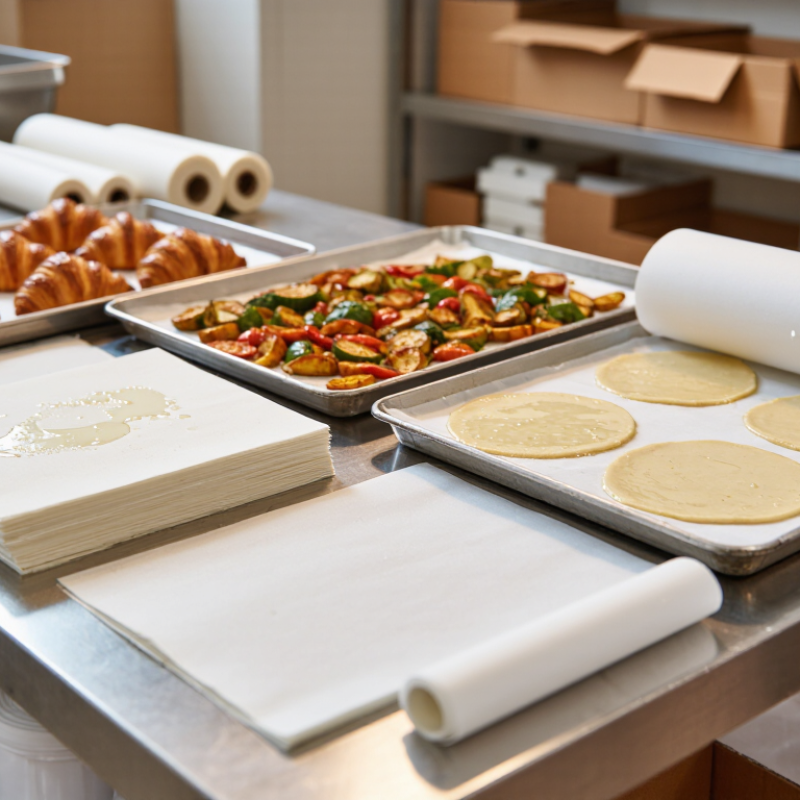
Experienced buyers usually request samples before approving a large order. Test them with oily pastries, wet dough, roasted vegetables, and repeated tray handling. Check release performance, curl, tearing, odor, and residue after baking. A parchment sheet may look smooth yet stick under real production pressure. I have learned that “universal” paper is often less universal than promised. That point deserves more testing.
Wholesale evaluation should also examine basis weight, silicone coverage, packaging strength, and carton labeling. Ask suppliers for technical data, food-contact documentation, batch traceability, and relevant third-party test reports. Requirements differ by market, so paperwork should match the destination country and intended use. Do not rely on a certificate image alone. Verify its scope, issuing organization, and validity. Pricing matters, but yield matters more: a slightly higher-quality sheet may reduce breakage and labor. Compare usable sheets per carton, not only the quoted unit price. Reliable suppliers explain tolerances honestly and respond clearly when samples fail. Parchment Paper should arrive clean, dry, and protected from crushing. Even then, humidity can change handling performance. Store trial cartons before making the final decision.
Define Wholesale Requirements: Use 30–60 GSM Grades for Different Applications
How to Choose Parchment Paper for Wholesale Buying?
Define Wholesale Requirements: Use 30–60 GSM Grades for Different Applications
Wholesale buyers should define the end use before comparing prices. Paper weight strongly affects flexibility, strength, grease resistance, and packing efficiency. FAO’s 2023 Forestry Production and Trade data reported approximately 423 million tonnes of global paper and paperboard production. That scale reflects intense demand for specialized paper products, including food-contact grades. In practical sourcing, 30–40 GSM parchment paper suits liners, separators, and lightweight wrapping. It folds easily and reduces material use.
For baking trays, steaming, and repeated handling, 40–50 GSM often offers better balance. A 50–60 GSM grade provides a firmer feel for oily foods, heavier portions, and transport packaging. However, higher GSM does not automatically mean better performance. Coating quality, porosity, moisture resistance, and heat stability also matter. A thick sheet can still tear after condensation. That detail is easy to overlook.
Tips: Request technical data before ordering. Check GSM tolerance, basis weight, temperature limits, and food-contact test results. Ask for samples from several production lots. Test them with real oils, sauces, freezer cycles, and oven temperatures. Measure curl and tearing after use. A 30 GSM sheet may perform well in one application but fail in another. Trial results should guide the final grade, not assumptions or attractive pricing.
Verify Food-Contact Compliance Under FDA 21 CFR 176.170 Standards
When choosing parchment paper for wholesale buying, start with food-contact compliance, not price or whiteness. FDA 21 CFR 176.170 covers paper and paperboard intended for contact with aqueous or fatty foods under specified conditions. Confirm that the product’s intended use matches those conditions.
Ask the supplier for a current compliance declaration, material specification, and migration or extraction test data. Review the paper’s coating, additives, silicone treatment, basis weight, and maximum temperature. A certificate alone is not enough. The document should identify food types, contact time, temperature limits, and applicable test conditions. Check whether the paper is designed for baking, wrapping, freezing, or repeated heating. These uses may create different compliance questions.
Wholesale buyers should also request lot traceability and production records. Compare the supplier’s claims with independent laboratory results when the application involves high heat or oily foods. Inspect sample rolls for odor, coating transfer, curling, and uneven release. Small defects become expensive across thousands of sheets. It is easy to overlook storage conditions, too; moisture and heat can affect performance before use. A practical checklist helps, but it is not perfect. Recheck documents when the formulation, factory, or intended application changes. Reliable purchasing depends on evidence, clear specifications, and careful follow-up.
Compare Heat Ratings Near 220–230°C for Baking and Industrial Use
How to Choose Parchment Paper for Wholesale Buying?
When comparing parchment paper, a 220°C rating should not be treated as a complete safety guarantee. In purchasing trials, I check whether the rating covers continuous heating, short exposure, or only laboratory conditions. A sheet used at 225°C for forty minutes faces different stress from one touching a hot conveyor for several hours. Ask for the test method and temperature tolerance data.
For baking, examine curling, browning, odor, and release after repeated oven cycles near 220–230°C. Paper weight matters too. A thin sheet may perform well with cookies but tear under heavy dough or commercial handling. A silicone-coated surface usually improves release, yet coating uniformity can vary across large rolls. Check several samples from different production lots.
Industrial buyers need wider testing. Heat cycling, pressure, moisture, and contact with oils can change performance. Request food-contact documents when the paper touches edible products. For non-food applications, confirm whether ash, smoke, or coating transfer affects the process. I also compare roll width, core size, cutting accuracy, and storage humidity. A supplier may advertise 230°C, but that number can hide practical limits. This is where my judgment remains imperfect. Small-scale tests can miss problems that appear during a full production shift.
Assess Silicone Coating, Release Performance, and Grease Resistance
Wholesale parchment paper decisions often begin with price, but coating quality deserves closer attention. Silicone coating controls how easily baked goods leave the sheet. A thin, uneven layer may cause cookies to stick around the edges. Excess silicone can raise costs and affect handling. Ask suppliers for coating specifications, production tolerances, and recent quality records. Samples should represent normal production, not specially selected rolls.
Release performance needs a practical test. Place sticky dough, caramel, or roasted vegetables on identical sheets. Bake them at the same temperature and for the same time. Observe lifting force, residue, tearing, and browning changes. A clean release is useful, but it is not the only measure. The paper should stay flat and avoid transferring silicone odor or taste. Test both sides when double-sided use is expected. Small differences matter in high-volume kitchens.
Grease resistance should be checked with oily fillings, butter-rich pastries, and long contact times. Look for seepage on the underside after cooling. Short tests can mislead. A sheet may resist warm fat yet fail during overnight storage. Basis weight, fiber structure, and coating cure all influence results. Request food-contact documentation from qualified suppliers. No test is perfect. Record humidity, oven type, and batch number before approval. A lower-priced option may still win if performance remains stable, but one inconsistent shipment can erase the savings.
How to Choose Parchment Paper for Wholesale Buying?
Assess silicone coating, release performance, and grease resistance using representative non-branded procurement benchmarks.
A balanced wholesale specification commonly targets a silicone coating of approximately 0.8–1.5 g/m², release force of about 10–30 gf/25 mm, and a grease resistance rating of KIT 8–12. Higher coating weight does not automatically guarantee better release; coating uniformity, curing, paper density, and storage conditions should also be verified through supplier samples and batch testing.
Calculate Wholesale Value Through MOQ, Roll Size, Yield, and Defect Rates
How to Choose Parchment Paper for Wholesale Buying?
Wholesale value begins with usable output, not the quoted carton price. In a purchasing review, record MOQ, roll length, width, and net weight. Then calculate total meters: MOQ multiplied by roll length. A 1,000-roll order with 300 meters per roll provides 300,000 meters before losses. If trimming removes 2%, and quality inspection rejects 1.5%, usable material becomes about 289,500 meters. The lower-cost offer may produce less.
Roll size also changes handling costs. Longer rolls reduce core, carton, and loading frequency, but they may increase damage during transport. According to PMMI’s 2024 packaging industry research, manufacturers continue prioritizing uptime, material efficiency, and labor reduction. That supports comparing yield, not only unit price. Ask suppliers for documented defect rates, inspection methods, and recent production records. A defect rate below 1% sounds attractive, but confirm whether it includes coating marks, edge tears, uneven cutting, and moisture damage.
Use this practical formula: wholesale value equals usable meters divided by total purchase cost. For example, 289,500 usable meters divided by a $42,000 invoice equals $6.89 per 1,000 usable meters. Compare that figure across MOQ levels. The FAO reported that 13.2% of food is lost before retail globally, highlighting why material reliability matters in food-related operations. Still, that figure does not predict parchment defects. It is only broader context. My own caution is simple: supplier averages can hide one poor shipment. Request samples from multiple batches, then measure actual yield before committing to a larger MOQ.
How to Choose Parchment Paper for Wholesale Buying? - Calculate Wholesale Value Through MOQ, Roll Size, Yield, and Defect Rates
Illustrative wholesale comparison based on standard unbleached parchment-paper roll specifications. Prices are shown in USD and exclude freight, duties, and taxes.
| Option | Paper Grade | Basis Weight
(g/m²) | Roll Width
(m) | Roll Length
(m) | MOQ
(Rolls) | Price per Roll
(USD) | Trim Yield
(%) | Defect Rate
(%) | Gross Area at MOQ
(m²) | Usable Area at MOQ
(m²) | Total Purchase Cost
(USD) | Effective Cost per Usable m²
(USD) |
| A | Standard baking grade | 40 | 0.33 | 100 | 500 | $18.50 | 96.0% | 1.5% | 16,500.0 | 15,594.6 | $9,250.00 | $0.593 |
| B | Standard baking grade | 40 | 0.40 | 200 | 300 | $31.80 | 97.0% | 1.2% | 24,000.0 | 23,001.6 | $9,540.00 | $0.415 |
| C | Heavy-duty baking grade | 45 | 0.45 | 300 | 200 | $44.60 | 96.5% | 0.9% | 27,000.0 | 25,821.3 | $8,920.00 | $0.345 |
| D | Wide food-service grade | 40 | 0.60 | 150 | 250 | $39.50 | 95.0% | 1.8% | 22,500.0 | 20,989.5 | $9,875.00 | $0.470 |
| E | Long-roll baking grade | 40 | 0.30 | 500 | 150 | $52.40 | 98.0% | 0.7% | 22,500.0 | 21,895.7 | $7,860.00 | $0.359 |
| F | Industrial food-service grade | 45 | 0.50 | 100 | 400 | $27.90 | 95.5% | 1.4% | 20,000.0 | 18,832.6 | $11,160.00 | $0.593 |
Usable area = Roll Width × Roll Length × MOQ × Trim Yield × (1 − Defect Rate). Effective cost per usable m² = Total Purchase Cost ÷ Usable Area at MOQ.
Wholesale evaluation focus: A lower price per roll does not always provide the best value. Compare usable square meters, MOQ cash commitment, roll dimensions, trim yield, and expected defect loss before placing a bulk order.


