

Finding a dependable Rf Divider manufacturer in China starts with clear electrical requirements, not a polished catalogue. Ericsson’s June 2024 Mobility Report projects 5.6 billion 5G subscriptions worldwide by the end of 2029, about 60% of mobile subscriptions. GSMA Intelligence’s The Mobile Economy China 2024 also documents China’s substantial mobile-network ecosystem. These reports provide useful market context, but they do not forecast divider sales or verify individual factories. That distinction matters.
A practical shortlist should connect each supplier’s claims to measurable evidence. Ask for datasheets covering frequency range, insertion loss, amplitude and phase balance, isolation, power handling, and impedance. Then compare those values with your design and request recent test reports for the exact model. Check whether the manufacturer can explain its calibration process, component traceability, production testing, and response to out-of-spec units. Details count. A neat sample can still hide inconsistent batch performance. Review relevant quality-system certificates, but confirm their scope and validity rather than treating a logo as proof. If possible, evaluate samples under your own test setup and operating conditions. Also confirm lead times, customization limits, connector options, and engineering support before discussing volume pricing. Not every supplier will disclose everything, and some specifications may need clarification. That is a reason to ask better questions, not to assume the worst. This evidence-led approach helps buyers identify capable Chinese manufacturers while keeping market growth separate from product-level proof.
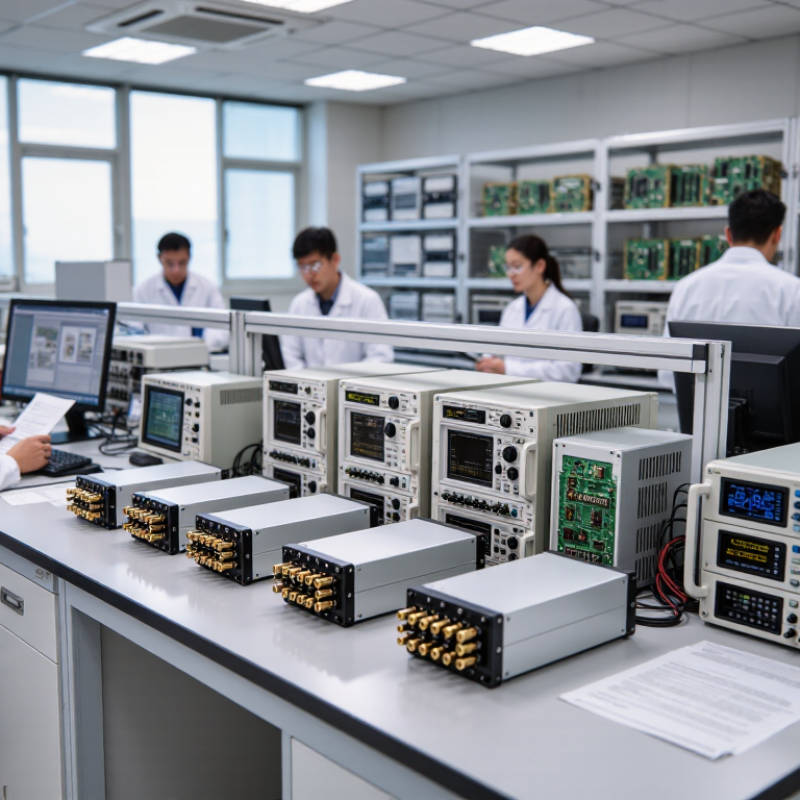
Before comparing RF divider manufacturers in China, define the operating conditions clearly.
Record the full frequency range, number of output ports, split ratio, and 50-ohm impedance requirement. Specify maximum insertion loss, port isolation, amplitude balance, and phase balance. These values affect performance in different ways. A low insertion loss alone does not guarantee a good divider.
Include practical details, too. Note the connector type, available installation space, operating temperature, and input power. For example, a divider fitted inside a shielded enclosure may need different connectors than one used on a test bench. Ask manufacturers for datasheets and measurement results across your actual frequency band. A calibrated vector network analyzer can verify key parameters, but test setup and cable effects matter. Requirements are often incomplete at first; revisit them after reviewing a sample.
Tips: Send the same specification sheet to each supplier. Request tolerance limits, test conditions, and sample inspection records. Check whether measurements cover every output port, not just a typical unit. Ask about lot-to-lot consistency and traceability. Small differences can matter. If your application has unusual temperature or power conditions, state them early. A specification that looks precise may still miss a real installation constraint.
China’s RF divider suppliers are concentrated around several electronics and microwave manufacturing hubs. Guangdong, especially the Shenzhen and Dongguan area, offers dense component supply chains and access to machining, PCB assembly, and test services. This can make prototype changes quicker. The Yangtze River Delta, including Shanghai, Jiangsu, and Zhejiang, also has established electronics and precision manufacturing capabilities.
Supplier types vary considerably. RF component specialists may focus on passive devices, impedance matching, and performance across defined frequency bands. Larger microwave manufacturers may combine design, fabrication, and testing under one roof. Contract manufacturers can assemble to a customer’s drawings, while trading companies may coordinate orders without owning production lines. Ask who performs the RF measurements.
A supplier’s location alone proves little. Request recent test data for insertion loss, isolation, amplitude balance, and operating bandwidth. Check whether the report identifies the test setup and calibrated equipment. A small workshop may produce a solid custom unit, but capacity and process records can be limited. I would verify these details before treating a sample as evidence of consistent production. The difference can be easy to miss.
When comparing RF divider manufacturers in China, look beyond catalog frequency ranges. Ask engineers how they handle insertion loss, port isolation, amplitude balance, and phase balance across the specified band. A capable team should explain test conditions, not just quote a best-case figure. Numbers need context.
Production capacity matters when moving from prototypes to repeat orders. Ask how many units can be assembled and tested each week, and whether capacity changes during peak periods. A factory visit can reveal practical details: dedicated RF test benches, organized component storage, and clear work instructions. A large floor alone proves little. Request a sample schedule and discuss how the manufacturer manages urgent revisions without disrupting routine production.
Quality systems should connect each unit to its materials, assembly steps, and test results. Check whether reports identify serial numbers, test frequency points, equipment, and acceptance limits. Ask how failed units are isolated and how corrective actions are recorded. That matters. A sample may perform well once, while consistent production is the harder test. Compare several units under the same test setup, and, where possible, repeat measurements with your own vector network analyzer. I would not rely on a polished report without checking its conditions; even careful suppliers can leave details unclear. Clear answers, repeatable measurements, and traceable records offer stronger evidence than confident sales language.
Assess manufacturer expertise, production capacity, and quality systems alongside the performance requirements of your application.
The chart shows the theoretical power-division loss for an equal split, calculated as 10 × log₁₀(N), where N is the number of output ports. It excludes real-world excess and insertion loss. When comparing suppliers, verify measured specifications, production capability, and documented quality controls.
When evaluating a Chinese RF divider manufacturer, check whether its certifications match the product and production site you are considering. Ask for current documents, their scope, and supporting test reports. A certificate is useful, but it does not prove that every divider meets your requirements. Check whether test results cover the specified frequency range, power rating, and connector type. Paperwork alone is not enough.
Request samples made to the same configuration as the quoted production units. Use calibrated test equipment and verify insertion loss, return loss, isolation, and amplitude balance across the operating band. Check phase balance too, if your application requires it. Record the test setup, cable arrangement, and instrument settings; small changes can affect readings. Repeat measurements on more than one sample, and compare results with the supplier’s data sheet. A clean report helps, but raw readings are better. This process takes time. It can also reveal gaps between a sample and a production promise. That detail is easy to miss when schedules are tight.
How to Find Top RF Divider Manufacturers in China
Compare Shortlisted Suppliers on Cost, Support, and Delivery Reliability
A low unit price is not the full cost. Compare like-for-like quotes for the same frequency range, port count, connector type, housing, and test requirements. Include tooling, minimum order quantity, packaging, freight, and any inspection fees. Ask suppliers to quote both sample and production orders. The difference can be revealing. A neat spreadsheet can still hide assumptions, so record what each quote excludes.
For technical support, request a sample test report with S-parameters, including insertion loss, isolation, and amplitude balance. Confirm the measurement conditions and whether production lots receive the same checks. Ask who handles design questions and how quickly they respond. For delivery, request a written schedule with sample, approval, and shipment milestones. The World Bank’s 2023 Logistics Performance Index ranked China 19th among 139 economies, with a score of 3.7 out of 5. This is useful national context, not proof of any supplier’s on-time performance.
Tips: Ask for recent, anonymized delivery records and agree on a clear delay-notification process. Compare landed cost, not just factory price. Keep the first order small; one trial may expose gaps that a polished presentation misses.
| Evaluation dimension | Suggested weight | Evidence to request and compare | Shortlisted Supplier A | Shortlisted Supplier B | Shortlisted Supplier C | Comparison rule |
|---|---|---|---|---|---|---|
| Technical fit | 25% | Model-specific datasheet covering frequency range, number of ports, impedance, power handling, amplitude and phase balance, insertion loss, isolation, and connector type. | Request datasheet; not independently verified | Request datasheet; not independently verified | Request datasheet; not independently verified | Score against the project specification; do not treat a catalogue range as proof that every configuration is available. |
| Quoted cost | 30% | Written quotation for the same part configuration and quantity, including tooling or setup charges, packaging, shipping terms, payment terms, and quote validity. | Quote required | Quote required | Quote required | Compare total landed cost on a like-for-like basis, not unit price alone. |
| Technical support | 20% | Named engineering contact, response-time commitment, support for specification review, sample evaluation, and corrective action for nonconforming units. | Confirm in writing | Confirm in writing | Confirm in writing | Score based on documented commitments and the quality of answers to technical questions. |
| Delivery reliability | 25% | Written production lead time, sample lead time, shipping method, delivery schedule, and evidence of on-time performance for comparable orders. | Lead time and evidence required | Lead time and evidence required | Lead time and evidence required | Prefer a confirmed schedule supported by order history or references; distinguish production time from transit time. |
| RF performance verification | Included in technical fit | Test report for the quoted model, with test conditions and frequency range; confirm how production units are inspected. | Request report and inspection details | Request report and inspection details | Request report and inspection details | Check that reported results correspond to the exact configuration being quoted. |
| Quality and traceability | Use as a qualification check | Quality-system documentation, lot or serial traceability, change-control process, warranty terms, and return or replacement procedure. | Documents required | Documents required | Documents required | Verify the scope and validity of documents; do not infer product performance from a certificate alone. |
| Scoring status | 100% total for weighted categories | Enter comparable evidence, then score each weighted category using the same scale for every supplier. | Not scored: supplier-specific evidence not provided | Not scored: supplier-specific evidence not provided | Not scored: supplier-specific evidence not provided | Shortlist only after technical compliance is confirmed; rank qualified suppliers by weighted score and total landed cost. |
RF reference: An ideal equal two-way divider splits input power into two outputs, corresponding to 3.01 dB per output; an ideal equal four-way divider corresponds to 6.02 dB per output. These are theoretical split values, not manufacturer-specific measured insertion-loss claims. Supplier entries above are placeholders because no supplier quotations, test reports, or delivery records were provided.

