

Choosing the right Charging Station is rarely a simple matter of comparing power ratings and prices. Global buyers must examine vehicle compatibility, electrical capacity, connector types, installation conditions, and long-term operating costs. A station that works smoothly in a European garage may perform poorly in a humid coastal warehouse or a cold Canadian driveway. Local requirements matter.
Real purchasing experience shows that small details often create the largest problems. Check whether the unit supports your vehicle’s charging standard and available voltage. Confirm cable length, weather protection, emergency controls, and mounting options. A clear display helps technicians identify faults beside a busy parking area. Remote monitoring can reduce service delays, but only when the software remains stable and the data connection is reliable.
Do not trust specifications alone. Review independent test results, warranty terms, safety certifications, and the manufacturer’s service network. Ask who will replace a damaged cable after eighteen months. Ask how firmware updates are managed across different regions. Some buyers focus heavily on maximum charging speed, although daily usage may not require it. That assumption deserves a second look. A slower station with stronger support, safer installation, and lower maintenance costs may deliver better value over its service life. Requirements also change as fleets grow, energy prices shift, and new vehicles arrive. Careful selection therefore combines technical evidence, installer experience, supplier credibility, and practical planning. Mistakes are possible, even with careful research. The goal is to make them visible before purchase.
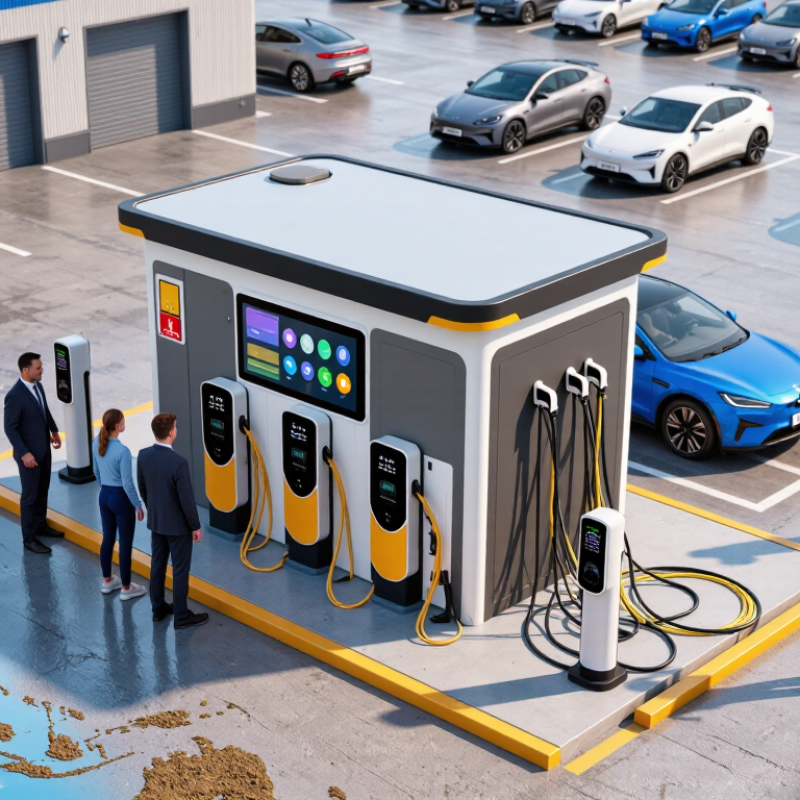
For global buyers, charger selection starts with a simple question: how long can each vehicle remain parked?
AC charging, typically 7–22 kW, suits homes, offices, hotels, and overnight depots. A 60 kWh battery may need about 5.5 hours at 11 kW under ideal conditions. Real charging takes longer because onboard chargers, temperature, and battery state reduce output. It is gentler on site capacity. Often overlooked.
DC charging, from 50–350 kW, serves highways, taxis, delivery fleets, and short-stop locations. A 60 kWh battery charged from 20% to 80% could theoretically receive energy in roughly 19 minutes at 150 kW. The vehicle may taper power near high battery levels, so the clock can disappoint.
The IEA Global EV Outlook 2024 reported more than four million public charging points worldwide in 2023. Public charging stock grew by over 40% that year. This growth makes uptime and queue management practical purchasing issues.
The same report identified fast charging as a rapidly expanding segment. Higher power demands thicker cables, stronger grid connections, cooling, and careful maintenance. The IEA Global EV Outlook 2025 recorded more than five million public charging points globally in 2024. Old assumptions may fail.
Buyers should compare daily energy throughput, peak demand charges, parking dwell time, and local electrical limits. A 350 kW unit may look impressive. It may be unnecessary. Site surveys and vehicle compatibility should decide the rating, not a headline specification.
Choosing a charging station starts with the local power system, not the connector shape. In North America, 120 V outlets suit overnight trickle charging, while 240 V circuits support faster residential charging. A 7.2 kW station at 240 V draws about 30 amps, requiring suitable wiring and protection. In many European and Asian markets, 230 V single-phase supply is standard. However, household capacity, phase balance, and installation quality still affect real charging speed.
The International Energy Agency’s Global EV Outlook 2024 reported nearly 14 million electric car sales worldwide in 2023. That growth makes regional electrical compatibility a purchasing priority. For commercial sites, 400 V and 800 V DC systems can deliver high power with lower current at the same output level. Yet an 800 V station does not automatically charge every vehicle faster. The vehicle battery, charging protocol, cable rating, and thermal management must all match.
Check the site carefully. A 400 V three-phase connection may need utility approval, load calculations, and professional commissioning. An 800 V installation also demands stronger insulation coordination and dependable cooling.
I have seen buyers compare only advertised kilowatts. That is a weak shortcut. The IEA Global EV Outlook 2025 notes that public charging infrastructure must expand rapidly to support rising electric-car adoption, but expansion without grid planning creates avoidable bottlenecks.
A voltage chart can mislead. Choose for the actual building, vehicle fleet, and daily charging pattern.
For global buyers, charging compliance is more than checking a connector photo. In procurement reviews, I examine the installation manual, test reports, and declared operating limits. IEC 61851 helps confirm communication and charging control between the vehicle and station. It does not automatically prove complete market access.
Check ISO 15118 support when advanced vehicle communication is required. It may enable structured data exchange, authentication, and managed charging features. However, software versions and vehicle compatibility can differ. Ask for a clear protocol matrix, not a vague “smart charging” claim. For AC charging, SAE J1772 may fit certain vehicle markets, while CCS combines charging communication with higher-power DC charging. Connector appearance can mislead.
Request independent test evidence and traceable production records. Confirm voltage, frequency, protection functions, enclosure rating, and emergency shutdown behavior. Local electrical rules still matter. A station may meet IEC 61851 yet require additional national approval or installation safeguards. That detail is often missed.
Test before scaling. Use vehicles from the target region, then check startup time, fault recovery, cable temperature, and charging stability. Keep sample logs. They expose small failures. A checklist is not enough. Even experienced buyers should review assumptions when vehicles, firmware, or grid conditions change.
| Standard or System | Primary Function | Electrical Scope | Communication and Control | Typical Regional Relevance | What Global Buyers Should Verify | Key Limitation or Note |
|---|---|---|---|---|---|---|
| IEC 61851 | Charging system standard Defines the general requirements and operating modes for conductive charging of electric vehicles. | Covers AC and DC conductive charging equipment, including safety functions, charging states, and control requirements. | Includes the control-pilot and proximity-detection concepts used to coordinate the vehicle and charging equipment. | Widely used as a core reference in IEC-based markets, including Europe, many parts of Asia, Africa, and Oceania. | Confirm the applicable edition, national deviations, rated voltage, current, ingress protection, protective devices, and required testing documentation. | IEC 61851 does not by itself define one universal vehicle connector or guarantee interoperability with every vehicle. |
| ISO 15118 | Vehicle-to-grid communication Defines higher-level digital communication between the electric vehicle and the charging station. | Supports communication for AC and DC charging and can be used with compatible charging systems and connector families. | Enables functions such as charging schedules, energy-transfer parameters, identification, smart charging, and, where supported, Plug & Charge. | Relevant to advanced charging deployments worldwide; implementation requirements depend on the local market and project design. | Check the supported ISO 15118 version, communication profile, certificate handling, Plug & Charge capability, cybersecurity process, and backend compatibility. | ISO 15118 support is not automatically included in every charger using CCS or another compatible connector. |
| SAE J1772 | AC interface standard Defines the conductive AC charging interface and related vehicle–charger signaling commonly used in North America. | Primarily associated with single-phase AC charging through the Type 1 connector; exact current and voltage ratings depend on the equipment design and local requirements. | Uses control-pilot signaling and proximity functions for connection status, current availability, and charging control. | Most relevant to the United States, Canada, and other markets that use the Type 1 AC interface. | Verify connector type, grid voltage and frequency, maximum AC current, local electrical certification, residual-current protection, and cable configuration. | The J1772 AC interface does not provide the same DC charging capability as a combined charging connector. |
| CCS | Combined Charging System Combines an AC charging interface with additional DC power contacts for fast charging. | CCS uses a Type 1 upper interface in Combo 1 configurations and a Type 2 upper interface in Combo 2 configurations. DC performance depends on the station, vehicle, cable, and installation. | Uses IEC 61851 control functions and can support higher-level communication based on ISO 15118 when implemented by both sides. | Combo 1 is associated mainly with North American applications; Combo 2 is widely used in Europe and many IEC-based markets. | Confirm Combo 1 or Combo 2, maximum DC voltage and current, cable cooling requirements, connector certification, communication support, and vehicle compatibility. | CCS is a system family rather than one single connector. A station with the wrong CCS variant will not directly match the vehicle inlet. |
| AC Charging Compatibility | Daily charging suitability Determines whether the station can provide practical low- or medium-power charging for the target vehicle fleet. | Depends on the vehicle's onboard AC charger, local supply configuration, phase count, voltage, current limit, and station rating. | Must correctly manage current limits, protective functions, connection status, and charging start/stop conditions. | Varies significantly between single-phase and three-phase markets and between national electrical systems. | Match the station rating to the vehicle's onboard charger and confirm supply type, circuit capacity, cable length, load management, and installation rules. | A higher station rating does not necessarily make the vehicle charge faster if the vehicle's onboard charger has a lower limit. |
| DC Fast-Charging Compatibility | High-power charging suitability Determines whether the station can transfer DC power directly to the vehicle battery. | Performance is limited by the lowest-rated element among the station, connector, cable, vehicle battery system, and site electrical supply. | Requires compatible charging control, safety checks, voltage and current negotiation, and fault handling. | Connector and communication requirements must be selected according to the target vehicle population and destination market. | Verify DC output range, peak and continuous current, connector variant, cable temperature management, protection functions, and vehicle test results. | Advertised peak power is not the same as guaranteed charging power throughout the session; thermal and battery limits may reduce output. |
| Global Compliance Review | Procurement checkpoint Confirms that the complete charging solution is suitable for the intended country and installation. | Review local voltage, frequency, earthing arrangement, overcurrent protection, residual-current protection, EMC requirements, and environmental conditions. | Check protocol interoperability, firmware management, network security, data interfaces, authentication, and remote monitoring requirements. | National rules may supplement or modify international and regional standards; local approval is essential before commercial deployment. | Request declarations of conformity, laboratory reports, installation instructions, protection diagrams, regional certificates, warranty terms, and software-support commitments. | A standards reference alone is not proof of legal market access. Certification and installation approval must be verified for the destination country. |
Global EV charging is expanding quickly. The IEA’s Global EV Outlook 2024 reported more than four million public charging points worldwide at the end of 2023. That growth makes enclosure testing and leakage protection practical buying criteria, not technical decoration.
IP54 offers limited dust protection and resistance to splashing water. IP65 is dust-tight and resists water jets. Neither rating confirms safe installation. A coastal parking area, for example, adds salt, condensation, and wind-driven rain. Ask for an IEC 60529 test report, not only an IP label. Check cable glands, door seals, and drainage paths. Small gaps matter.
6 mA DC detection is equally important. Under IEC 61851-1 and IEC 62955 principles, a charging unit can detect smooth DC residual current and disconnect before it affects upstream protection. It does not replace grounding, overcurrent protection, or the required residual-current device. Confirm the detection threshold, response time, and test method in the technical file. Certification from an independent laboratory strengthens confidence. Still, paperwork can be incomplete. I have seen specifications that mention “DC protection” without explaining whether detection is built in or external. Buyers should verify compatibility with local electrical rules, supply voltage, climate, and maintenance capability before comparing prices.
Global buyers should treat OCPP selection as an operational decision, not a feature checklist. The International Energy Agency reported more than four million public charging points worldwide at the end of 2023. That scale increases the need for reliable communication between chargers and management systems.
OCPP 1.6J supports common functions, including remote start, status monitoring, authorization, and basic load control. It is often suitable for smaller deployments. However, its device model and diagnostics are less detailed. OCPP 2.0.1 offers stronger device management, smarter charging controls, improved transaction handling, and broader security capabilities. It also better supports future integration with energy systems and vehicle communication. Migration may still expose compatibility gaps.
Uptime deserves equal attention. A 95% uptime target allows about 438 hours of downtime annually. That sounds acceptable until a busy charging site loses service during weekends, holidays, or fleet dispatch hours. The European Union’s Alternative Fuels Infrastructure Regulation uses a 97% availability benchmark for certain publicly accessible charging infrastructure, showing that 95% is a modest commercial threshold.
A protocol alone cannot guarantee uptime. Buyers should verify network monitoring, offline authorization, spare-part response, firmware procedures, and monthly incident reports. Ask for uptime measured per connector, not only per site. Small details matter. OCPP 2.0.1 can improve visibility, but it may require newer hardware, trained technicians, and careful testing with existing systems. The cheaper migration path is not always the more reliable one.

