How to Choose the Best Pastry Maker for Your Bakery?
Choosing the right Pastry Maker can shape your bakery’s daily rhythm, product quality, and labor costs. A machine that handles delicate dough gently may suit a croissant-focused shop. A high-capacity mixer may matter more when trays of cookies and sponge cakes fill the schedule. The best choice is not always the largest or most expensive. It is the one that fits your menu, staff, and production volume.
The celebrated chef and baking teacher Julia Child is often credited with saying, “A party without cake is just a meeting.” The line is playful, but good pastry takes serious consistency. Before comparing models, list your most frequent batches, dough weights, available counter space, and cleaning needs. Check bowl capacity and speed controls against real recipes, not just a product’s headline specifications. Ask suppliers for a demonstration using ingredients similar to yours. Watch how evenly the machine mixes, how much noise it makes, and whether staff can clean it without awkward workarounds.
A detail gets missed. Service access matters, especially during busy weeks. Review warranty terms, spare-part availability, and local repair support before committing. If possible, speak with bakery owners who use the same model for similar products. Their experience can reveal practical issues that a brochure will not. No machine fixes a poorly planned workflow. And a perfect fit today may feel limiting as your menu grows. Use this guide to compare mixer types, essential features, capacity, maintenance, and cost, then choose with your bakery’s actual routine in mind.
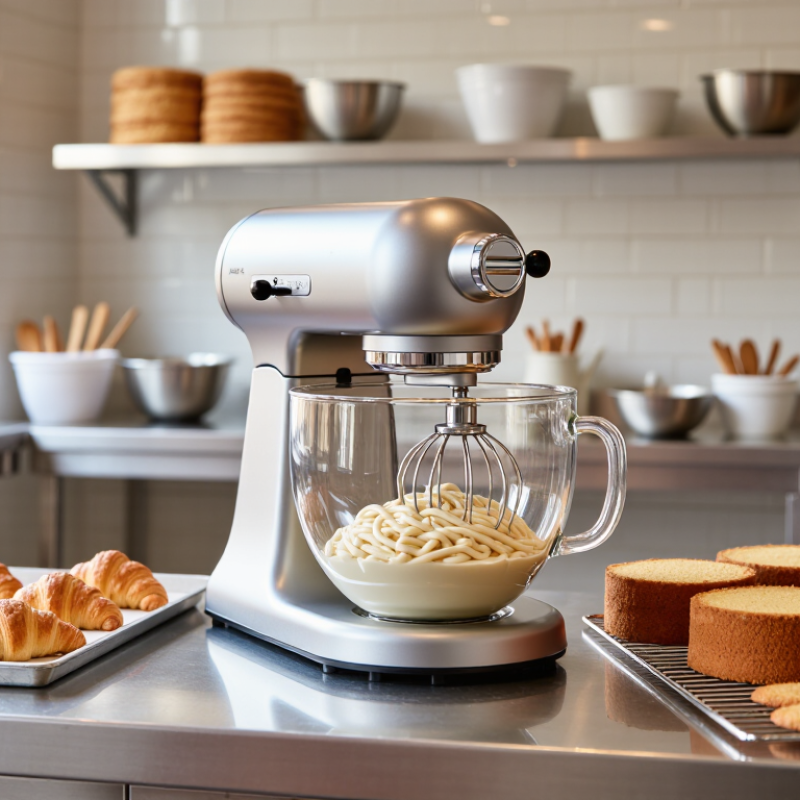
Identify Your Bakery’s Pastry Production Needs
Before choosing a pastry maker, map what your bakery actually produces. Record each pastry type, batch size, dough consistency, and daily peak—not just average—volume. A croissant line may need controlled sheeting and folding, while choux pastry may depend more on consistent mixing and depositing. Note available floor space, electrical capacity, cleaning time, and how many staff can operate the equipment. Small details matter. A machine that handles your busiest hour may still be unsuitable if changeovers interrupt several product lines.
Use sales records to estimate demand by product and season, then compare that forecast with realistic operator capacity. The U.S. Bureau of Labor Statistics projects baker employment to grow 5% from 2023 to 2033, a useful reminder to include labor availability in equipment planning (Occupational Outlook Handbook, 2024). USDA estimates that 30–40% of the U.S. food supply is lost or wasted; that figure covers the wider food system, not bakeries alone, but it underscores why batch sizing and unsold-product tracking deserve attention (USDA, Food Loss and Waste). Your forecast will still be imperfect. Track leftover dough, rejected pieces, and cleaning downtime for several weeks, then adjust your target throughput before buying. We often focus too much on maximum capacity. In practice, the right machine must also fit the smallest batch you make on a quiet Tuesday.
Compare Pastry Maker Types, Capacities, and Functions
A pastry maker can mean several machines, and their jobs differ. A planetary mixer handles creams, batters, and moderate dough batches with interchangeable tools. A dough sheeter rolls pastry evenly into thin sheets, reducing repeated hand-rolling. A depositor portions soft mixtures quickly, but it cannot replace a mixer or sheeter. Choose by the work your menu actually requires.
Capacity figures need context. A large bowl may not mix a small batch evenly, while a compact sheeter can slow production during a busy morning. Estimate your peak-hour output, then compare usable batch size, cycle time, and cleaning time. For example, count how many trays of tart shells you need before lunch—not just how many liters a machine holds. Capacity charts can mislead.
Check the functions against your ingredients and staff routine. Variable speeds, adjustable roller gaps, and removable food-contact parts can improve control and simplify cleaning. Ask for a demonstration using a realistic batch, including stiff pastry dough if that is part of your menu. Listen for strain, inspect the pastry thickness, and note how long changeovers take. Small details matter. A machine that fits today’s volume may feel limiting later; still, buying excess capacity can waste space and energy. Recheck your estimates.
How to Choose the Best Pastry Maker for Your Bakery
Compare typical dough capacity per batch across common commercial mixer types.
How to read the chart: The bars show indicative working-capacity ranges in kilograms of dough per batch. Planetary mixers suit versatile, smaller batches; spiral mixers are designed for bread and other doughs; fork mixers handle gentle mixing; and horizontal mixers suit larger-scale production.
Capacity varies by model, recipe, and dough hydration. Check the machine’s rated dough capacity—not just its bowl volume—before purchasing.
Evaluate Performance, Materials, and Ease of Operation
A pastry maker should suit the bakery’s real workload, not just look fast on a product sheet. Compare its output with your usual dough and batch sizes. Check whether portions stay even when the machine runs continuously, and note how quickly it resumes after a brief stop. Speed is not everything. Uneven pieces can create extra handwork and inconsistent baking.
Materials affect hygiene, wear, and maintenance. Look for smooth food-contact surfaces with few gaps where dough or flour can collect. Stainless steel is often practical, but the frame, joints, and moving parts also deserve inspection. Ask how components are removed for cleaning and whether common wear parts are accessible. Small details matter. A difficult-to-clean hinge can cost more time than expected.
Ease of operation shows up during a busy shift. Controls should be clear, adjustments simple, and safety guards easy to check. If possible, let different staff members run a normal batch; observe setup time, awkward reaches, and cleanup. A quiet showroom test may not reveal those problems. One drawback may remain: a compact machine can save floor space but limit batch size. Weigh that trade-off against your daily production needs.
Check Cleaning Requirements, Safety, and Maintenance Support
When choosing a pastry maker, inspect the parts that collect flour, butter, and damp dough: guards, paddles, seals, and the bowl rim. Can staff remove them without tools? Are hidden corners reachable with a brush? The FDA Food Code 2022 emphasizes that food-contact equipment should be cleanable and accessible for inspection. Treat that as a useful design benchmark, then confirm the machine’s cleaning instructions with the supplier. A quick demonstration beats a glossy brochure.
Cleaning affects more than appearance. The CDC estimates that foodborne illnesses cause about 48 million illnesses in the United States each year (Foodborne Illnesses and Germs, 2011 estimates). That figure covers all food, not bakery equipment alone, but it shows why routine sanitation deserves attention. Ask how often seals and blades need inspection, which parts are wear items, and whether replacement parts are readily available. Get response times for service in writing. In a busy bakery, a mixer stopped mid-shift can leave dough waiting on a warm bench. Unpleasant, and avoidable.
Check that operators can follow the cleaning steps during a real shift, not just during a showroom demonstration. One detail is easy to miss: overly complicated routines often get shortened when orders pile up. Still, paperwork can look better than the machine. Ask for a maintenance schedule, service records, and clear instructions for checking loose fittings or worn seals.
Compare Total Costs and Test Suitable Models
How to Choose the Best Pastry Maker for Your Bakery?
Compare the full cost, not just the purchase price. Include delivery, installation, electrical work, routine servicing, and replacement parts. A lower-cost machine may need more frequent repairs or take longer to clean. Small costs add up. Estimate how many batches you make on a busy day, then compare that workload with each model’s rated capacity. Allow room for staff training and possible downtime; these costs are easy to overlook.
Tips: Test suitable models with your own dough, if possible. Run a typical batch and a larger one. Check mixing consistency, temperature, noise, and how easily staff can scrape and wash the bowl. Test it cold. A brief demonstration may look smooth, but a full cleanup often tells you more.
Record the results in a simple comparison sheet. Note batch time, texture, cleanup time, and any awkward controls. Ask about service intervals and the expected availability of common parts. Consider where the machine will sit, too: measure doorways, work surfaces, and clearance for the bowl. No trial predicts every problem. Still, testing can expose a poor fit before it becomes an expensive daily frustration.


