China Top Dishwasher Tooling Manufacturer for Global Buyers
China has become a major sourcing destination for global dishwasher manufacturers. Its factories combine mold design, precision machining, heat treatment, and production testing under one supply network. This integration can shorten development time and reduce communication gaps.
Dishwasher Tooling covers more than a metal mold. It includes progressive dies for stainless-steel tubs, injection molds for spray arms, and fixtures for rack assembly. A reliable manufacturer studies material thickness, forming direction, cooling channels, ejection marks, and detergent resistance. Small details matter. A poorly balanced cooling circuit may create warpage. A weak punch may leave visible dents inside the tub.
Industry tooling specialist Dr. John P. Beaumont offers a practical principle: “Design for manufacturability begins before the mold is cut.” This idea remains important for overseas buyers. Early reviews should examine CAD files, steel grades, tolerance plans, maintenance access, and expected production volume. Factory experience also matters. Engineers should inspect trial parts, measure critical dimensions with a CMM, and document every correction.
Not every project runs perfectly. Delays can occur. Communication may be incomplete. A promising quotation can hide expensive changes later. Buyers should request clear sampling schedules, inspection records, spare-part plans, and after-sales support before approval. China’s strongest tooling suppliers do not simply promise fast delivery. They explain risks, test assumptions, and improve weak points openly.
For global buyers, the right Dishwasher Tooling partner is a technical collaborator. Price matters, but repeatable quality matters more. A well-built tool should produce accurate parts, stable cycles, and manageable maintenance for years.
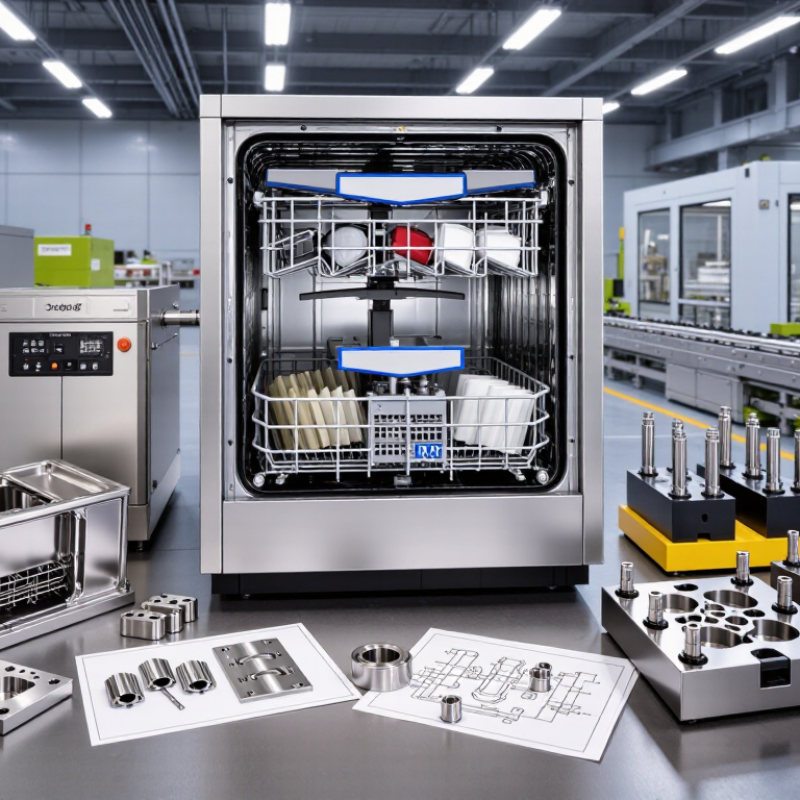
Dishwasher Tooling Manufacturing in China: An Industry Overview
China’s dishwasher tooling industry supports global appliance production through mold design, machining, testing, and maintenance. Manufacturers commonly produce injection molds for control panels, spray arms, filters, racks, and structural plastic parts. Sheet metal tooling is also used for brackets, panels, and internal supports.
Experienced tooling teams begin with product drawings and material requirements. They review wall thickness, shrinkage, draft angles, and expected production volume. This prevents many defects before steel is cut. Skilled engineers often use flow analysis to identify weak filling areas and possible warping. Small details matter.
Tool steel selection affects service life and repair costs. Cooling channels must be positioned carefully around thick sections. Poor cooling may create cycle delays or uneven surfaces. Precision machining, dimensional inspection, and trial molding help verify the tooling before shipment. Reliable suppliers provide inspection records, sample parts, and maintenance guidance for overseas buyers.
However, no tooling program is flawless. Design changes can disturb schedules, especially after machining begins. Some low quotations exclude testing, spare inserts, or export packaging. Buyers should confirm tolerances, mold life, delivery milestones, and communication procedures in writing. A factory visit or live production inspection can reveal practical details that drawings miss. Clear technical feedback also improves cooperation across language and time-zone differences.
China remains competitive because its tooling supply chain combines engineering labor, machining capacity, material access, and export experience. Yet cost alone is not enough. Consistent quality depends on process control, honest reporting, and careful after-sales support.
China Top Dishwasher Tooling Manufacturer for Global Buyers
Dishwasher Tooling Manufacturing in China: Typical Tool Steel Hardness
This chart shows representative hardness targets commonly used for tooling steels in dishwasher component molds and dies. Actual specifications vary according to the part material, production volume, surface requirements, and heat-treatment process.
Unit: HRC (Rockwell C hardness). Values are typical engineering reference points, not company-specific data.
How Chinese Manufacturers Design and Build Dishwasher Tooling
Chinese dishwasher tooling manufacturers design molds around production reality, not only digital drawings. Engineers study the appliance structure, detergent exposure, water pressure, and expected cycle volume. They then convert these requirements into a detailed mold layout.
A typical project begins with 3D part analysis. The team checks wall thickness, draft angles, weld lines, and possible deformation. Flow simulation helps locate gates and cooling channels. Steel selection depends on abrasion, corrosion risk, and service life. For complex inner tubs, precise machining and controlled polishing protect the final surface quality.
The tooling shop builds the mold through CNC machining, electrical discharge machining, fitting, and trial molding. Technicians measure critical dimensions with coordinate equipment. They also inspect short shots, flash, sink marks, and uneven cooling. Small changes matter. A few tenths of a millimeter can affect assembly.
Not every trial is smooth. Sometimes cooling performs differently from the simulation. That result deserves investigation, not excuses. Experienced teams adjust inserts, venting, or processing conditions, then record each change. This traceable approach supports repeatable production for global buyers and makes later maintenance more practical.
Communication also shapes tooling quality. Engineers confirm resin data, machine parameters, packaging limits, and inspection standards before steel cutting. Clear feedback prevents expensive assumptions. A reliable manufacturer provides trial reports, dimensional records, maintenance guidance, and realistic delivery updates. Error-free work is an attractive idea, but disciplined correction is closer to real manufacturing.
How to Select a Reliable China-Based Tooling Manufacturer
China Top Dishwasher Tooling Manufacturer for Global Buyers
Selecting a reliable China-based tooling manufacturer requires evidence, not attractive catalog photos. Ask for recent mold projects, steel certificates, dimensional reports, and trial records.
The U.S. Department of Energy’s 2023 dishwasher test procedure assumes 215 cycles annually. That figure highlights the need for durable molds and stable production tolerances. Check whether the supplier measures critical parts with a CMM, especially door frames, spray-arm interfaces, and sealing surfaces. A low quote can still be expensive.
Request a documented tooling plan. It should show design review, steel preparation, machining, polishing, sampling, and corrective actions. Confirm who owns the drawings and how revisions are controlled. Ask for video evidence of a real trial, not only finished samples.
The World Bank’s 2023 Logistics Performance Index ranked China 19th among 139 economies, but strong logistics cannot repair poor inspection. No audit is perfect. A supplier may pass one visit and still miss a tolerance later.
Tips: Compare at least three factories using the same technical checklist. Require a first-trial report with measured values, photos, and open defects. Clarify cavity balance, expected tool life, spare-part support, and response times before ordering. ISO 9001 certification can support process discipline, but it does not prove tooling accuracy. Review actual records. Ask difficult questions. That step is often skipped.


