China Best Automated Injection Molding Manufacturers?
Choosing the best China Automated Injection Molding manufacturers requires more than comparing prices or factory photographs. A reliable supplier should demonstrate practical experience with your material, part geometry, mold design, and production volume. Ask how engineers manage warpage, weld lines, cooling balance, and cycle-time variation. These details often separate a stable production partner from a capable-looking vendor.
Look for facilities with documented process controls, trained technicians, preventive maintenance records, and traceable quality inspections. A modern line may include robotic part removal, automatic material drying, vision inspection, and real-time machine monitoring. Request sample parts, dimensional reports, mold-trial records, and evidence of consistent batch performance. Proof matters more. Certifications can support credibility, but they should not replace an on-site audit or technical discussion. No shortlist is perfect. Even experienced manufacturers may struggle with unfamiliar resins, complex undercuts, or demanding cosmetic surfaces. A stronger evaluation asks how the supplier responds when results miss specifications. Do they adjust tooling, review data, and communicate clearly? That response reveals operational maturity. It is also wise to compare response times, engineering support, packaging methods, and after-sales service. The cheapest quotation may create higher costs through rework, delayed shipments, or frequent mold adjustments. This guide examines leading Chinese manufacturers through measurable capabilities, customer-focused engineering, production reliability, and transparent communication. Some rankings remain subjective. Your product requirements should decide the final choice.
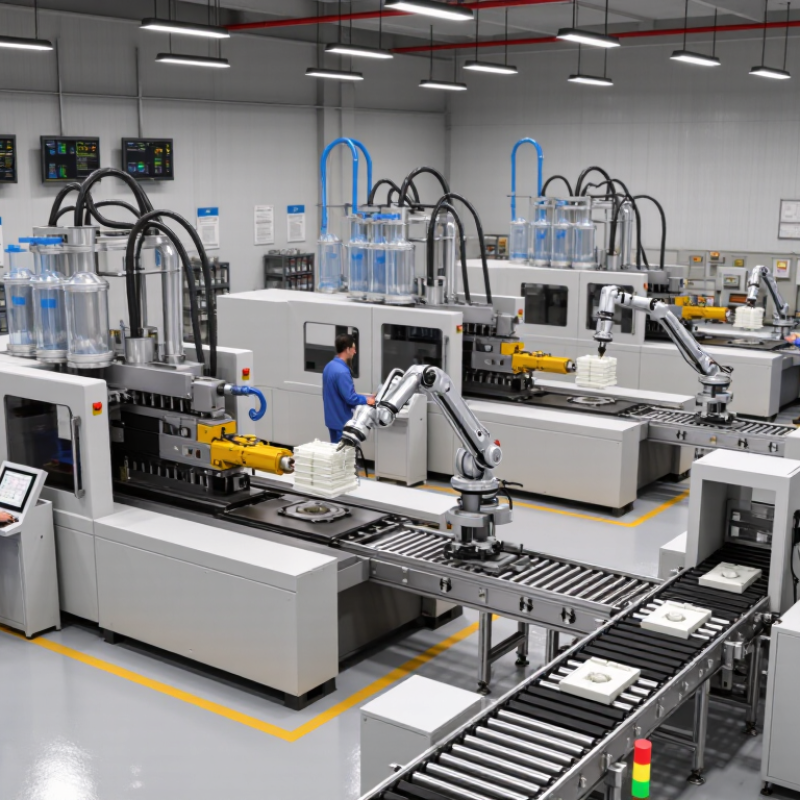
Defining Automated Injection Molding Manufacturing in China
Automated injection molding manufacturing in China means more than adding a robot beside a press. It combines servo-controlled machines, robotic part removal, automatic feeding, vision inspection, and production software. These systems create a connected cell. They can record cycle time, mold temperature, pressure, and defect trends. Operators still matter. Their experience helps correct flash, short shots, warpage, and unstable material drying.
China’s scale supports rapid automation. The International Federation of Robotics reported 276,288 industrial robots installed in China during 2023. That represented about 51% of global installations. PlasticsEurope’s Plastics—The Fast Facts 2024 reported global plastic production of 413.8 million tonnes in 2023. Such volume increases pressure for repeatable molding and traceable quality. A capable manufacturer should provide documented process validation, preventive maintenance records, and measurable scrap data. Automation is not magic. A poorly designed mold still produces bad parts faster. Some factories also overstate data collection while relying on manual spreadsheets. That gap deserves scrutiny.
Tips: Ask for a live production demonstration. Check robot recovery after a fault. Review sample inspection reports. Confirm material drying controls and mold-change procedures. Request energy data per molded kilogram. Small details expose weak systems. Also question whether software works with existing equipment. A perfect new cell may become expensive if integration remains incomplete.
Key Technologies Used by Chinese Injection Molding Manufacturers
China Best Automated Injection Molding Manufacturers?
Key Technologies Used by Chinese Injection Molding Manufacturers
Leading Chinese injection molding manufacturers increasingly combine servo-electric machines, robotic handling, and real-time production software. Servo drives control screw movement with high accuracy and reduce unnecessary energy use. Six-axis robots remove molded parts, trim runners, and place components into trays. In a well-tuned cell, the robot repeats each movement within a narrow tolerance. Small timing errors can still damage delicate parts.
Machine vision systems inspect flash, short shots, color variation, and surface marks during production. Cameras compare each part with approved reference images. Sensors also monitor mold temperature, injection pressure, cooling time, and material moisture. These measurements help engineers identify unstable conditions before large batches are affected. Moisture control matters greatly when processing engineering plastics.
Many factories connect machines through manufacturing execution systems. Operators can review cycle data, alarm history, material usage, and maintenance records from one interface. Predictive maintenance uses vibration, temperature, and motor-current signals to detect possible failures. This approach supports traceability and more reliable delivery. However, software cannot replace experienced technicians. A wrong sensor setting may create confident but inaccurate data.
Mold flow analysis is another valuable technology. Engineers simulate filling, cooling, warpage, and weld-line risks before machining the mold. Automated mold-temperature controllers then stabilize production from cycle to cycle. Some facilities use digital twins for process testing, but these models are not always perfect. Real resin behavior can differ from laboratory assumptions. Practical trials remain necessary.
How to Evaluate China’s Automated Injection Molding Suppliers
China Best Automated Injection Molding Manufacturers?
When evaluating China’s automated injection molding suppliers, inspect the complete cell, not only the press. Watch a robot remove a part, a vision system check it, and a conveyor separate rejects. Ask for cycle-time records, uptime logs, and sampled dimensional results from ordinary production. Tours can mislead.
China installed 276,288 industrial robots in 2023, equal to 51% of global installations, according to the International Federation of Robotics’ World Robotics 2024 report. This scale suggests strong integration capacity, but robot quantity does not prove molding competence. Request a written scope covering mold protection, safety circuits, material drying, tooling, and data ownership. Confirm compliance with ISO 20430:2020 and relevant workplace-safety requirements. Then test recovery after a simulated sensor failure.
Supplier quality also appears in validation discipline. Require capability studies for critical dimensions, documented change control, spare-parts lead times, and operator training records. Compare measured OEE with the quoted figure, using identical definitions for availability, performance, and quality. Request energy data in kilowatt-hours per kilogram during stable production, not a showroom cycle. Lower cost may hide slower service. Some evaluations remain imperfect. Language gaps, unclear acceptance criteria, and optimistic cycle times can distort comparisons. A paid pilot with agreed samples, acceptance limits, and a 30-day support test gives stronger evidence.
Leading Manufacturer Capabilities and Production Specialties
China Best Automated Injection Molding Manufacturers?
Leading manufacturers combine injection molding expertise with practical automation. Their factories may use robotic part removal, automatic feeding, vision inspection, and real-time machine monitoring. These systems reduce handling errors and keep cycle times stable. However, automation is not automatically better. Poorly designed tooling can still create flash, warping, or uneven filling.
Strong suppliers usually support precision molding, multi-cavity tooling, insert molding, and overmolding. Some specialize in automotive housings, electronic components, medical devices, or thin-wall packaging. Production capability should include mold-flow analysis, controlled material drying, and documented process parameters. A reliable manufacturer also provides dimensional reports, batch traceability, and clear corrective-action records. Ask about mold maintenance intervals. Small details matter.
Tips: Request sample parts from the intended material and production method. Review inspection points, not only surface appearance. Confirm whether robots and sensors are maintained by trained technicians. Check how the factory handles rejected parts and process changes. A production line may look impressive, yet its records can be incomplete. That deserves attention. Evaluate communication speed, engineering feedback, and pilot-run discipline before placing a large order.
Quality, Compliance, Pricing, and Export Considerations
China’s Best Automated Injection Molding Manufacturers: Quality, Compliance, Pricing, and Export Considerations
Choosing an automated injection molding manufacturer requires more than comparing hourly rates. Quality starts with repeatable process control, not attractive brochures. Ask for cavity-pressure records, dimensional inspection reports, resin-lot traceability, and documented corrective actions. The ISO Survey 2023 recorded more than 1.2 million ISO 9001 certificates worldwide. Still, certification alone does not prove stable production. A certificate is not perfection. During supplier audits, inspect mold maintenance logs, robot calibration records, and first-article samples. Small details matter, especially at high production volumes.
Pricing should include tooling, engineering changes, validation, packaging, freight, duties, and replacement parts. A lower quotation may hide weaker steel, limited testing, or expensive export preparation. Request a transparent cost breakdown and confirm payment milestones before production. For compliance, define applicable requirements early, including material declarations, electrical safety, labeling, and environmental restrictions. The exact obligations depend on the destination market and product category. Do not assume the factory understands every local rule. Export reliability also deserves measurable evidence. China scored 3.7 out of 5 and ranked 19th in the World Bank’s 2023 Logistics Performance Index. UNCTAD’s Review of Maritime Transport 2023 states that shipping carries over 80% of global merchandise trade by volume. Yet port delays still happen. A realistic supplier should provide tested packaging, shipping documents, and contingency plans, not optimistic promises.
China Automated Injection Molding Supplier Evaluation Framework
The chart presents a practical 100-point purchasing framework for evaluating automated injection molding suppliers in China. Quality and process capability receive the highest weighting, while compliance, total landed cost, and export readiness address certification, tooling, logistics, documentation, and delivery risk. These are buyer-side evaluation weights rather than ratings for any specific company.


