

Choosing a Small Travel Motor in 2026 requires more than matching a product name to a machine size. The correct choice depends on torque, displacement, pressure, speed, and operating conditions. A mini excavator working on wet clay needs different performance from a tracked carrier moving across concrete. Begin with the machine’s total weight, track width, travel speed, and available hydraulic flow. Then compare these figures with verified manufacturer performance curves. Do not rely on attractive catalogue claims alone. Heat matters. Continuous operation, steep slopes, and frequent direction changes can expose weaknesses quickly. A motor with high peak torque may still perform poorly if its continuous rating is too low.
Installation details also deserve careful attention. Confirm port sizes, mounting dimensions, shaft design, brake requirements, and planetary gearbox compatibility before ordering. A few millimetres of mismatch can create leaks, vibration, or premature bearing wear. Ask suppliers about efficiency, sealing materials, filtration recommendations, warranty coverage, and spare-part availability. Reliable technical documents matter more than vague promises. Field feedback from experienced mechanics can reveal practical issues that specifications miss. That assumption fails. A simple selection chart cannot replace load calculations and site testing. Even careful sizing may overlook cold-start conditions, contaminated oil, or an operator’s driving habits. Review the decision honestly, leave a suitable safety margin, and choose a Small Travel Motor supported by traceable data and responsive technical service.
Choosing a small travel motor starts with three measurable requirements: speed, torque, and load capacity. Field practice shows that guessing these values often causes overheating, slow travel, or premature gear damage. Measure the machine’s actual travel speed, sprocket radius, total mass, slope, and working surface.
Calculate traction force from rolling resistance, gradient force, and acceleration demand. Then estimate output torque with this formula: T = F × r ÷ η. Here, F is total traction force, r is sprocket radius, and η is drivetrain efficiency. Motor speed should match the reduction ratio: n = 60v ÷ 2πr. The 2024 Off-Highway Research market outlook highlights continuing demand for compact equipment, where limited installation space makes correct power matching especially important. Small packages leave less room for thermal mistakes.
Load capacity needs separate checking. Include machine weight, attachments, uneven ground, shock loads, and side loads. Do not use rated payload alone. The bearing and final-drive ratings must withstand both static and dynamic forces. ISO 16750-3 testing guidance also emphasizes vibration and mechanical shock in mobile equipment environments. A practical design review may apply a 1.2–1.5 service factor, but the correct value depends on duty cycle and manufacturer data. I would verify torque at the hottest operating condition, not only on paper. That detail is easy to miss.
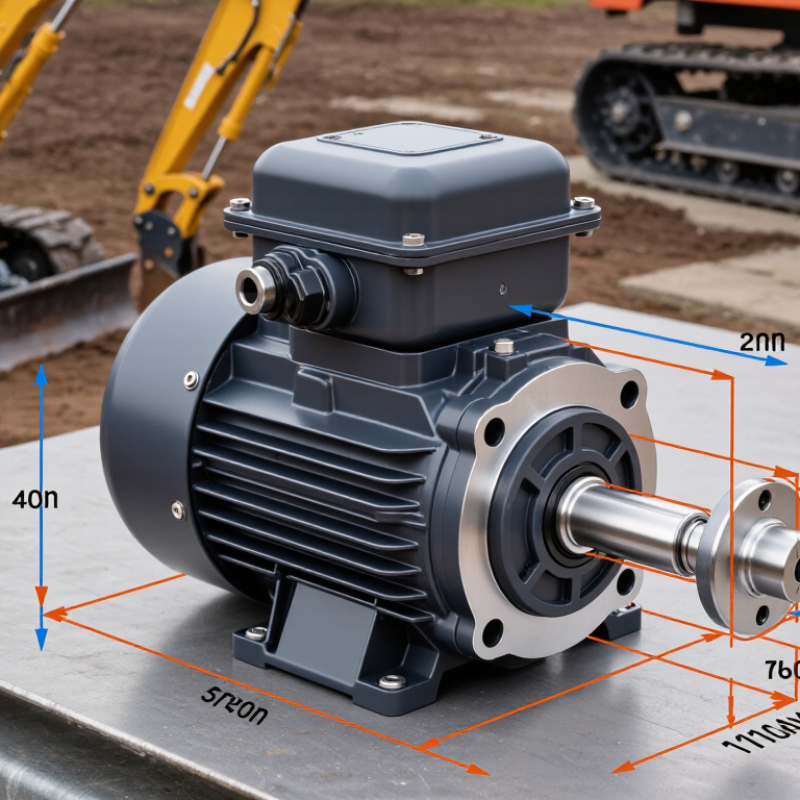
Choosing a small travel motor starts with the machine, not the catalog. Measure available length, width, height, bolt-circle diameter, shaft position, and port orientation. Leave service clearance around fittings and brake components. A motor that fits on paper may fail beside a frame rib or crowded hose.
Match displacement to required torque and speed. For hydraulic systems, theoretical torque equals pressure multiplied by displacement, divided by 2π. Flow determines rotational speed. Check both values at working pressure, not only peak pressure. A compact motor may deliver strong starting torque but overheat during continuous travel. The IEA’s Energy Efficiency 2023 report estimates motor-driven systems use about 53% of global electricity, showing why efficiency deserves attention, even in compact equipment.
Power supply needs equal care. Confirm hydraulic pressure, flow, filtration, oil temperature, or electrical voltage and current. For electro-hydraulic controls, verify the coil voltage and connector space separately. The ISO 4413 hydraulic safety standard stresses suitable components, clean fluid, and controlled energy release. Those details are easy to overlook. They should not be.
Use the manufacturer’s performance curve and your real duty cycle. A 12- or 24-volt control circuit does not define motor output. Nor does a larger displacement automatically mean better travel. I have seen compact installations lose speed because hose restrictions were ignored. Recheck the layout at full steering lock and after thermal expansion. That extra check is rarely wasted.
How to Choose a Small Travel Motor in 2026?
Efficiency is more than a catalog percentage. A poorly matched motor can waste energy during repeated starts, turning, and slope work. The International Energy Agency reports that electric motor systems consume about 46% of global electricity. Even small improvements matter. Check hydraulic or electrical efficiency at the loads your machine actually faces. Ask for test conditions, not only peak figures. A cooler housing, stable speed, and lower battery or fuel use are practical signs of efficiency.
Noise reveals design quality. Compare sound-power data measured under ISO 3744 conditions, rather than trusting “quiet” marketing language. Listen near the operator’s position after thirty minutes of operation. Whine, vibration, and sudden tonal changes may indicate poor alignment or rising internal wear. Durability depends on sealing, bearing protection, lubricant compatibility, and contamination control. ISO 4406 cleanliness codes provide a useful reference for hydraulic fluid quality. Environmental protection also requires attention to leakage, recyclable materials, efficient packaging, and restricted substances under current RoHS requirements. Real sites are messier than test benches.
Tips: Request a duty-cycle test, cold-start results, and noise readings. Inspect the drain port and seal area after field trials. Leave margin for dust, water, and overloads. I would not choose the lightest unit automatically; that decision can age badly. Ask for service intervals and failure-rate evidence from independent testing.
The chart compares typical engineering characteristics of small brushed DC, brushless DC, and stepper motors used in compact travel equipment. Brushless DC motors generally provide higher efficiency and longer service life, while brushed DC motors are often quieter at low speed and simpler to control. Stepper motors offer precise positioning but may consume power while holding position.
How to Choose a Small Travel Motor in 2026?
For a small travel motor, evaluate the complete system, not only its wattage. Start with safety. Look for documented testing against relevant standards, including ISO 7176-25:2022 for batteries and chargers used with powered wheelchairs. Check the charger, too. It should include overcharge, overheating, and short-circuit protection. The WHO and UNICEF Global Report on Assistive Technology estimates that more than 2.5 billion people need assistive products worldwide. That scale makes dependable design essential, especially during airport transfers or steep hotel ramps.
Smart features should solve real problems. Battery temperature warnings, fault codes, speed limits, and location sharing can improve daily control. Avoid unnecessary apps. The IEA’s Global EV Outlook 2025 reported more than 17 million electric cars sold worldwide in 2024, showing how quickly battery technology is expanding. However, a compact motor may still use less-proven components. Ask for battery cycle data and software update procedures. I once focused too heavily on range. That was a mistake. Weight, charging time, and weather protection mattered more.
Compare purchase price with batteries, tires, transport cases, and annual servicing. Request a written five-year cost estimate. Maintenance support should include response times, spare-part availability, and technician training. A two-year warranty sounds attractive, but vague exclusions can weaken it. Test the motor with your actual luggage. Small details matter.
A practical comparison of common compact electric motor configurations for portable travel applications
| Motor Configuration | Typical Rated Output | Typical Travel Range per Charge | Safety Standards and Checks | Useful Smart Features | Estimated System Cost in 2026 | Routine Maintenance | Best Use Case |
|---|---|---|---|---|---|---|---|
| Brushed DC Motor | 180–350 W | 8–15 km | Battery protection system, fuse or circuit breaker, charger temperature control, and compliance with the applicable local mobility-device safety rules. | Battery-level indicator, basic fault code display, speed limiter, and overload protection. | US$450–900 | Inspect brushes and terminals periodically; clean connectors; check tire pressure and brake operation. | Short urban trips where low purchase cost and simple repair are priorities. |
| Brushless DC Hub Motor | 250–500 W | 12–25 km | Look for protected wiring, battery-management-system over-current protection, secure battery mounting, and a documented water-resistance rating such as IP54 or higher. | Regenerative braking, electronic diagnostics, cruise-control setting, app-free dashboard alerts, and battery health estimation. | US$700–1,400 | Check wheel bearings, cable insulation, brake sensors, and charging-port seals every 3–6 months. | Frequent travel with moderate hills and a need for quiet, low-maintenance operation. |
| Geared Brushless Motor | 300–600 W | 15–30 km | Verify thermal cut-off, electromagnetic compatibility testing, mechanical locking of the folding frame, and battery transport documentation including UN 38.3 test evidence where applicable. | Hill-start assistance, torque control, fault logging, electronic anti-rollback, and configurable acceleration. | US$900–1,800 | Inspect gear noise, seals, folding joints, brake pads, and fastener torque; replace worn drivetrain parts as required. | Longer daily routes, inclines, and users who need stronger low-speed torque. |
| High-Torque Dual-Motor System | 500–1,000 W combined | 18–35 km | Require independent motor cut-off, redundant braking, thermal monitoring, battery short-circuit protection, and clear maximum-load documentation. | Selectable drive modes, traction control, wheel-speed monitoring, GPS location function, and service diagnostics. | US$1,300–2,600 | Inspect both motors, controllers, brakes, suspension, battery balance, and software error logs at least twice per year. | Heavier loads, steeper routes, or outdoor travel where additional traction is necessary. |
| Low-Voltage Sealed Motor System | 200–450 W | 10–22 km | Prioritize double-insulated wiring, sealed connectors, charger certification for the destination market, battery over-temperature protection, and an IP rating suitable for expected weather exposure. | Battery temperature readout, maintenance reminders, automatic sleep mode, and remote diagnostic access. | US$800–1,700 | Keep connectors dry, inspect seals, test the charger, and store the battery in a cool, dry place at partial charge. | Air travel planning, indoor use, and environments where compact size and weather protection matter. |
| Evaluation Dimension | Recommended Minimum Requirement | Questions to Ask Before Purchase |
|---|---|---|
| Safety | Battery-management protection, thermal cut-off, reliable braking, secure folding locks, and documented electrical testing. | Which safety standard applies in my country? Is the complete system tested, or only the battery or charger? |
| Battery | A removable lithium-ion battery with verified capacity, over-charge protection, and documented transport compliance where relevant. | What is the usable watt-hour capacity, replacement cost, expected cycle life, and charging time? |
| Smart Features | Useful diagnostics, battery-health information, speed control, and fault alerts rather than unnecessary connectivity. | Do essential functions work without a mobile app or subscription? Can diagnostic data be exported? |
| Total Cost | Compare purchase price, spare battery, charger, tires, brake components, shipping, insurance, and possible subscription fees. | What is the estimated three-year ownership cost, including battery replacement? |
| Maintenance Support | Published service intervals, accessible replacement parts, repair documentation, and a support channel with a defined response time. | Are batteries, controllers, brakes, tires, and connectors available separately for at least three years? |
| Portability | Manageable folded dimensions, a practical lifting weight, and a removable battery when transport or airline rules require it. | What are the folded dimensions, heaviest removable part, and permitted battery watt-hour limit for my transport method? |
Cost, range, and output figures are indicative market ranges for compact electric travel systems. Actual performance depends on rider or payload weight, terrain, temperature, tire pressure, riding speed, battery age, and local regulations.

